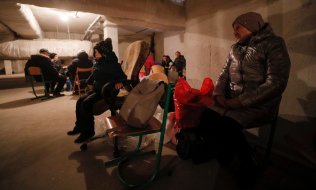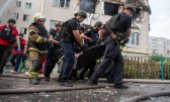
People in Kyiv shelter from missile attacks in the basement of a school on February 24. (© picture alliance/EPA/SERGEY DOLZHENKO)

  Russia's war against Ukraine

  40 Debates

Ukraine celebrated the 34th anniversary of its declaration of independence from the former Soviet Union on Sunday - in the midst of a war in which Moscow is trying to regain control of the country. Commentators highlight key moments for a country that is having to fight for its sovereignty like no other in Europe today.

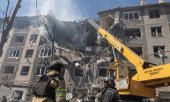
Russian Foreign Minister Sergei Lavrov has said that a peacekeeping operation carried out by European troops in Ukraine would be "absolutely unacceptable" for Moscow and that at this stage a summit meeting between the presidents of Russia and Ukraine would be premature. The Russian military has also intensified its air strikes on Ukrainian cities. Europe's press sees little scope for peace negotiations.

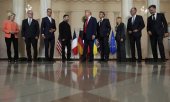
The leaders of five European countries attended Monday's Ukraine summit in Washington, but there were no representatives from Eastern European EU member states. Eastern European media outlets ask why these countries' support for Ukraine and their proximity to the war zone aren't giving them a more prominent role.

Following redoubled diplomatic efforts to achieve peace at the summits in Alaska and Washington, discussions are now focusing on what form the West's security guarantees for Ukraine could take. Europe's commentators look at who can provide support, and in what form, and whether such measures can deter Russia in the long run.

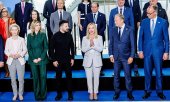
In the wake of the Alaska summit, Ukrainian President Volodymyr Zelensky and the leaders of five European states, the EU and Nato convened with Donald Trump at the White House on Monday to seek a solution to the war in Ukraine. According to Trump, following a phone call with Putin preparations for a meeting between the Russian leader and Zelensky are under way. The press response is mixed.

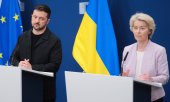
After Friday's summit in Alaska, Ukrainian President Volodymyr Zelensky is travelling to Washington today – accompanied by EU Commission President Ursula von der Leyen and several European leaders – to discuss the future of Ukraine with US President Donald Trump. Commentators review what Europe must do to make itself heard in the White House and the Kremlin.

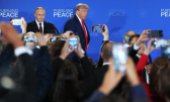
All eyes are on Alaska, where Donald Trump is meeting Vladimir Putin this Friday - the first such encounter between a sitting US president and the Russian President since 2021. The focus of the talks will be ways to end the war in Ukraine. Commentators alternate between optimism and doubt.

In the run-up to Friday's Alaska summit between Donald Trump and Vladimir Putin, several European leaders participated in a video conference with the US president, laying out key points for possible peace talks, including a ceasefire based on the current front line and security guarantees for Ukraine. The media assess the chances of success.

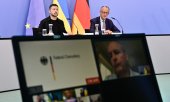
Ahead of the planned meeting between US President Donald Trump and Russian President Vladimir Putin in Alaska, German Chancellor Friedrich Merz has invited European leaders to a virtual summit. The participating countries - including Ukraine - aim to coordinate a common stance and convey it to the US. Commentators assess the motives of those involved.

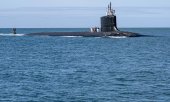
Following a verbal exchange with former Russian President Dmitry Medvedev, US President Trump has announced that he will send two US nuclear submarines to "appropriate regions". The details remain confidential. Prior to this, Medvedev had criticised the US ultimatum to Russia to end the war in Ukraine, saying it was a threat and a step towards war, which Trump in turn described as "foolish and inflammatory". The European press takes stock.

US President Donald Trump has shortened the 50-day deadline he set in July as an ultimatum to Russia and given President Putin just ten more days to agree to a ceasefire in the war against Ukraine. After that, Russia's trade partners could face tariffs of up to 100 percent, he warned. Commentators debate the consequences of the announcement.

Volodymyr Zelensky will restore the independence of Ukraine's anti-corruption authorities. Following fierce criticism from both Ukrainians and his Western allies, the president announced that he would submit a new bill to parliament repealing the regulations passed this week. What conclusions can be drawn from this sudden reversal?

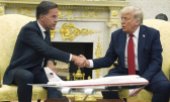
US President Donald Trump has adopted a harsher tone vis-à-vis Russia. He announced on Monday that Ukraine is to be equipped with Nato-financed US weapons, including Patriot missiles, and that if an agreement to end the war wasn't reached within 50 days, Washington will impose punitive tariffs of up to 100 percent on Russia and its trading partners. Europe's press takes a look at the potential impact of this new rhetoric.

The Ukrainian State Bureau of Investigation (SBI) has launched proceedings against Vitaliy Shabunin, the head of the Anti-Corruption Action Centre and one of the country's best-known civil society activists. Because he also serves as a volunteer in the army, he is now accused of evading military service and using an army vehicle for private purposes. The media sound the alarm.

Shortly after Ukraine was hit by the heaviest airstrikes since the start of Russia's large-scale invasion in 2022, the annual Ukraine Recovery Conference is taking place in Rome on 10 and 11 July. The EU has advocated a reconstruction fund for critical sectors, to be supplemented by private investment, while President Zelensky has called for assistance with drone production, energy supplies and air defence, as well as the release of frozen Russian funds for reconstruction.

Last week the Pentagon pulled the plug on sending weapons to Ukraine. Now Donald Trump has overturned the decision – and is reportedly looking into whether the US can deliver an additional Patriot missile defence system. He also condemned Vladimir Putin for throwing "a lot of bullshit" while "killing a lot of people". Europe's press anaylses the latest mood swing in the White House.

Russia's Transport Minister Roman Starovoit was fired from his post on Monday without explanation. A few hours later he was found shot dead in his car. Investigations into his death are still underway but the authorities are treating it as suicide. Commentators link the incident with the incursion of Ukrainian troops into Russia's Kursk region in 2024, where Starovoit had been governor since 2019.

The US government plans to halt deliveries of certain weapons to Ukraine. Pentagon spokesman Sean Parnell said on Wednesday that a comprehensive review was underway to determine which weapons systems would be affected, but that there were still robust options for the provision of military aid to the country. Commentators discuss motives and potential consequences.

In its 'Operation Spider's Web', Ukraine attacked five military airfields in Russia with drones launched from trucks on Sunday. According to its own reports a total of 41 aircraft were destroyed. Video footage has so far shown twelve long-range bombers in the Murmansk and Irkutsk regions that had either been completely destroyed or damaged. The media discuss the impact of the attack.

The Russian government has proposed resuming negotiations on a ceasefire in Istanbul on Monday and said it will set out its terms in a memorandum. Meanwhile, at a meeting in Berlin on Wednesday German Chancellor Friedrich Merz assured Ukrainian President Volodymyr Zelensky that Germany would provide five billion euros in military aid.

German Chancellor Friedrich Merz on Monday lifted restrictions on Ukraine's use of Western weapons against military targets in Russia, saying that this was necessary for the country to be able to defend itself effectively. With this move Berlin has aligned itself with other allies whose weapons systems have already been approved to this end. However, although it has long-range weapons in the form of Taurus cruise missiles, Germany has refused to deliver them to Kyiv so far.

Russia launched a massive offensive involving hundreds of drones and missile strikes against Ukraine on the weekend, while a number of Ukrainian missiles were intercepted in the Moscow region. At the same time the two warring countries completed a 1,000-for-1,000 prisoner swap - the biggest since the war began. US President Trump criticised both President Putin as 'absolutely crazy' and President Zelensky, for 'causing problems'.

Russia's war against Ukraine is increasingly perceived not just as a military conflict, but as a battle against the Western way of life as a whole. A glance at Europe's media reveals that at many different levels the question of how to deal with direct and indirect Russian influence is being posed.

After his phone call with Russian counterpart Vladimir Putin, US President Donald Trump proposed the Vatican as a venue for peace talks on the Ukraine war. Italian Prime Minister Giorgia Meloni has indicated that she would support Pope Leo XIV in the negotiations. According to the Wall Street Journal, these could begin in mid-June.

After a two-hour phone call with his Russian counterpart Vladimir Putin, US President Donald Trump announced that peace talks aimed at ending Russia's war against Ukraine could begin immediately. Putin explained that Moscow wanted to end the hostilities, but that it was still necessary to determine the most effective ways to move towards peace. Europe's press greets the news with a large dose of scepticism.

On Tuesday, a Russian fighter jet briefly entered Nato airspace after the Estonian navy tried to intercept an unflagged tanker in the Baltic Sea which apparently belongs to Russia's "shadow fleet". The national press calls for consequences.

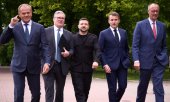
The leaders of Britain, Germany, Poland and France visited Volodymyr Zelensky in Kyiv on Saturday, where they made a joint phone call to Donald Trump and also reiterated the demand for a 30-day ceasefire as a starting point for negotiations - threatening that otherwise new sanctions against Russia would follow. European media outlets assess the impact of the EU leaders' visit.

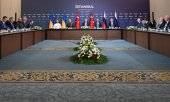
Talks between Ukraine and Russia will begin today in Istanbul a day later than planned. Vladimir Putin, who first proposed the negotiations, will not attend. In the meantime Putin has extended Russia's defence plan by two years. The EU plans to impose new sanctions on Russia as of Tuesday.

Russia is celebrating the Soviet victory over Nazi Germany with a large military parade today. State guests from around 30 countries including Belarus, China, Slovakia and Brazil are attending. Commentators examine the symbolism of the ostentatious celebrations as the country wages war against Ukraine, as well as the motives of those attending.

This week the whole of Europe commemorates the end of the Second World War and liberation from National Socialism. Russia will celebrate the victory over Hitler's Germany with its usual massive military parade on 9 May. The Kremlin's efforts to place its current war of aggression in Ukraine in this historical context meet with opposition in the European press.

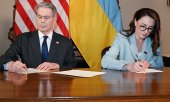
Following tough negotiations, Ukraine and the US have signed a natural resources deal. Hailed by both sides as a "historic" agreement, it provides for the creation of a joint investment fund which will initially generate funds for the country's reconstruction. The media assess the deal primarily in terms of its potential to boost Ukraine's security and sovereignty.

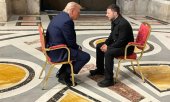
On the sidelines of Pope Francis's funeral, US President Donald Trump and his Ukrainian counterpart Volodymyr Zelensky met in St. Peter's Basilica on Saturday to discuss the war in Ukraine. While the White House described the meeting as "very productive", Zelensky said it had the potential to become historic. Commentators debate whether their talk could be a turning point.

Donald Trump has announced that Washington and Moscow have agreed on terms for ending the war in Ukraine: "I think we have a deal with Russia," the US president said on Wednesday, adding that Russia was making a big concession by agreeing to end the war now rather than seizing the whole country. Russian Foreign Minister Sergei Lavrov also said that Russia was in principle ready to conclude an agreement. Trump had previously lambasted Zelensky for refusing to cede on his country's right to keep Crimea.

Representatives of Ukraine and key European allies are meeting in London today to discuss a potential solution for peace. US special envoy Keith Kellogg will also be attending. Reports in US media according to which Washington would be prepared to recognise Crimea (annexed by Moscow in 2014) as Russian are causing a furore, as is Trump's reported ruling out of Nato membership for Ukraine.

On Holy Saturday Vladimir Putin unilaterally announced a 30-hour ceasefire, which was accepted by Ukraine. While the truce was only partially observed on the front lines, there were no air strikes on either side. Commentators analyse the situation in light of Donald Trump's threat to withdraw US mediation if the parties refuse to cooperate.

US President Donald Trump has described a Russian missile strike on the city of Sumy in north-eastern Ukraine in which more than 30 civilians were killed as a "horrible thing". Russian-American negotiations are set to continue this week, but with only a ceasefire on the Black Sea on the table. The media ask whether Trump's peace initiative has any chance of succeeding - and examine what role Europe can play.