
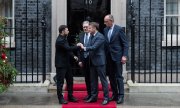
Upshot of the Ukraine peace meeting in London?
At a meeting in London on Monday, Ukrainian President Volodymyr Zelensky, German Chancellor Friedrich Merz, French President Emmanuel Macron and British Prime Minister Keir Starmer discussed how to proceed on the war in Ukraine. The 28-point peace plan presented by the US was shortened to exclude positions that were 'anti-Ukrainian' (Zelensky) and now comprises 20 points. Once the details have been ironed out, the plan will be sent to Washington.
A last-ditch attempt
Zelensky is trying hard, but whether he can succeed is questionable, La Stampa laments:
“In a tour de force across Europe over the last two days – London with the E3 (Britain, France and Germany), Brussels, Rome – the Ukrainian president has backed another 'plan' which now comprises 20 points. It probably contains the maximum concessions Ukraine can make, including – no doubt added at the last minute – elections within 60 days. Zelensky and the Europeans are hoping that Trump will advocate the plan vis-à-vis Putin without Moscow making new demands. ... This is a last-ditch attempt to reach a lasting agreement between Russia and Ukraine in which the US sides with Kyiv rather than Moscow.”
Diplomacy at a dead end
In a Facebook post picked up by Glavkom, political scientist Viktor Shlinchak writes:
“Europe can exert pressure on China whenever it wants to by giving Beijing an ultimatum: either it pushes Putin to end the war in Europe or it will face additional tariffs and trade restrictions on the European market. The situation is more complicated with the US. It all boils down to Trump being able to tick off the issue of negotiations for the time being. ... One thing is clear: whatever Ukraine and Europe propose will not be acceptable to Russia. No 'peace plan' that doesn't involve our surrender (military, economic and political) can be in Moscow's interest. But as long as Washington takes the lead and allows the diplomatic machine to keep running, the process must continue.”
Europe has no plan
Political scientist Vadym Denyssenko voices disappointment in a Facebook post republished by Espreso:
“The meeting in London showed that Europe has no idea what to do next. At best, Europe can provide financial resources – but clearly not enough to bring about a turning point in the war. What's more, Europe as a whole has a problem called 'security', and doesn't know how to deal with it. So it seems that decisions are now being made according to the principle: 'If you don't know what to do, put off solving the problem until later.' In our reality, it sounds like this: 'The war will definitely continue, and perhaps there will be money for it.'”