
Might is right: the end of international law?
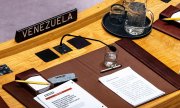
Relations between major powers and smaller neighbouring states seem to be guided less by legal norms and more by naked power politics these days. After the US captured Nicolás Maduro in Venezuela, seized two shadow fleet tankers and repeated threats to take over Greenland, all within the space of a week, Europe's media voice grave concern about the decline of international law and rules.
The concerns of ordinary people are ignored
American-Polish journalist Anne Applebaum writes in Gazeta Wyborcza:
“If the stronger party is always right, then the United States can do whatever it wants by whatever means it chooses in its sphere of influence - without having to worry about transparency, democracy or even any semblance of legitimacy. Not to mention the worries of ordinary people in smaller countries. Their interests are of no concern to imperialist companies, which only care about their natural resources, or to imperialist leaders, who need propaganda about their conquests to hold on to power in their own countries.”
The others are always the bad guys
The law of the strongest has enthusiastic supporters, Novaya Gazeta observes:
“We behave like football fans. Whoever we support is in the right, simply because we're their fans. In the conflicts between Israel and Hamas, Trump and Venezuela - we're in the right, because we're good and the others are bad. The problem is that the 'bad guys' also consider themselves to be good and are convinced that truth is on their side. And as laws become a tiresome formality, whoever has more power is in the right. How can Trump reproach Putin? Putin follows the same logic and his own understanding of justice. ... And there will certainly always be people who show understanding for anything and everything. ”
Bad news for Eastern Europe, too
There is no longer any guarantee that Putin's expansionist ambitions will be stopped, Maszol fears:
“There couldn't have been worse news for Ukraine [than the situation in Venezuela] because the Russian invasion may now appear in a completely different light, with fatal consequences for the already uncertain peace process. The inhabitants of the Republic of Moldova also have reason to feel even more uneasy because the Russians could one day invade this small country citing, for example, the violation of the rights of the Gagauz and Russians in Transnistria. Who will prevent this, given that international law is dead thanks to Donald Trump?”
Dividing the globe into three parts
A global geopolitical realignment is underway, writes economics professor Jože P. Damijan in Dnevnik:
“A few days ago, a map began circulating on the internet. It shows the world divided into American, Russian and Chinese spheres of influence – a caricature that comes close to the new reality. The world is moving towards a new, informal division of zones of influence – a kind of Yalta 2, but this time with no formal treaties, no ideological coherence and no institutions that could stabilise such an order. The US, Russia and China are increasingly defining the areas in which they exercise raw power, while withdrawing from or adopting a passive stance towards other regions. Trump's Venezuela clearly illustrates the logic of this new order.”
At least Macron is no longer silent
France's President Emmanuel Macron has accused the US of "breaking away from international rules." Finally, someone is fighting back, La Stampa rejoices:
“With the words he spoke before the French ambassadors yesterday, the master of the Élysée Palace took the risk of directly challenging American power and, after months of humiliation and subservience, breaking with the European Union's policy of appeasement. ... But after the publication of the report on American security strategy, the military intervention in Venezuela and the threats against Greenland, Macron has acknowledged the existence of two different, conflicting world views and declared it pointless, counterproductive and dangerous not to oppose Trump's predatory policies.”