
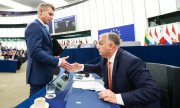
Election day set: Hungary in campaign mode
Hungarian President Tamás Sulyok announced the date for the 2026 parliamentary elections on Tuesday. The Hungarians will decide on 12 April who governs their country: Viktor Orbán's Fidesz party, which has been in power for 16 years, or Péter Magyar's Tisza party. Several opinion polls put the Tisza party ahead of Fidesz. Commentators predict a heated campaign.
Resurrection of democracy after Easter?
Népszava expects things to get dirty:
“The election campaign officially kicks off now, but in reality it has already been underway since 2006. Against this backdrop, it's clear that we all have three tough months ahead of us and will no doubt be inundated with an unprecedented flood of intrigue and mudslinging in the run-up to 12 April. The final days of the election campaign include the Easter holidays, and it's clear that there won't be even a moment of respite even during those holidays. Nevertheless, many people are confident that it will all be over a week later – with the election campaign and something else, too: perhaps there will be a belated resurrection.”
Orbán as Europe's patriotic standard-bearer
Both Orbán's supporters and his detractors in other countries will be keeping a close eye on the Hungarian election, writes the pro-government daily Magyar Nemzet:
“This election is important for those who hope the government will collapse so that patriotic forces in Europe are weakened and they can expand the war [in Ukraine]. But perhaps it is even more important for the citizens of those countries that have long yearned for a leader like Viktor Orbán, whose renewed victory will give them strength for their own struggle against Europe's traitors.”
No more anti-Ukraine rhetoric
European Pravda analyses the reasons for Orbán's change of tone vis-à-vis Ukraine:
“In the lengthy speech the prime minister gave [at the 31st Fidesz party conference], which set the tone for the election campaign, there was no mention whatsoever of the 'Ukrainian threat'. ... Nor did Orbán even touch on the subject of Ukraine's future EU membership, the accession process or the Hungarian veto. ... Why not? ... Is it because this argument no longer resonates with voters? Or (which seems a more likely explanation) has Orbán's entourage decided to take account of the fact that Donald Trump also now publicly supports the idea of Ukraine joining the EU and agreed to include this point in his 'peace plan'?”