
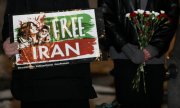
What comes next in Iran?
According to a representative of the Iranian government, 5,000 people have been killed during the recent wave of protests in Iran, 500 of whom were members of the security forces. The Sunday Times puts the number of deaths at 16,500 or more, however. Washington had initially stated it would stage a military intervention. Then, on Wednesday, Donald Trump announced there would be no intervention for now as the regime had cancelled its plans to carry out executions.
Executions now carried out in secret
In a Telegram post reposted by Echo, Military expert Sergey Auslender suspects that Iran has by no means suspended the planned executions:
“As for the 'cancelled' executions, that's complete nonsense. They will kill in prisons or in remote locations, of which there are plenty, instead. In summary proceedings, a bullet in the head, solely on the basis of someone having been arrested, regardless of the circumstances under which they ended up there. It will mainly be young men who are executed, of course. ... Anyone who says that the regime is in its death agony and that it is doomed is right. Absolutely right. The only question is how many people the regime will take down with it.”
Trump has let the Iranians down before
Profil emphasises that the blocking of the opposition's communication channels could have been prevented:
“When Donald Trump became US president, he issued an executive order closing down the US Agency for International Development (USAID) and suspending the activities of the Bureau of Democracy, Human Rights, and Labor in the US Department of State. This included funding for tools such as Starlink and Psiphon to support the Iranian opposition. ... As a result of this shortsightedness, opposition groups in Iran waited in vain for further support last year. And consequently, at perhaps the most significant point in their lives, they were less prepared than they could have been. ... Dissidents in dictatorships must not be abandoned.”
Deceived by empty promises
NRC sharply criticises Trump:
“The American president acted completely irresponsibly when he declared the United States was 'fully prepared' for military intervention, that 'help was on the way', and encouraged the Iranians to take over state institutions. Anyone who makes announcements like that and then fails to follow through is deceiving the Iranians, who need to weigh up whether they can risk their lives by taking to the streets. ... It is not that easy to bring down the Iranian regime. ... The opposition has to be able to rely on well-considered help from outside. Something that was lacking in this case.”
Opposition needs a leader
Without a leader, there is no chance of a revolution, Habertürk comments:
“In recent days, there has indeed been unrest in Iran. However, the reason for this is not opposition to the regime, but financial difficulties and starvation caused by the embargo. ... The events should not be downplayed, but they are not big enough to topple the regime. Especially in comparison to past protests, particularly the unrest in 1979 that led to the fall of the Shah – they can't even be described as large demonstrations. For a social movement to become a revolution that overthrows the regime, there has to be a leader capable of inspiring the masses.”
Dual strategy against the uprising
The regime has managed to stifle the protests using violence and internet blackouts, writes Corriere della Sera:
“The Basij paramilitary force was tasked with crushing the uprising by supporting the police in the cities. At the same time, cyber units attempted to shut down all channels to the outside world, while the government imposed an internet blackout. The authorities repeated what they had done in the past, only this time a strict blockade seemed to make their strategy more effective. Because they had learned their lesson, corrected their mistakes and improved their equipment. They wanted to kill and then minimise any 'evidence' of their actions by preventing the dissemination of videos and cutting off contact with the outside world.”
Reminiscent of Syria's descent into hell
Iran could face the same fate as Syria, fears France Inter:
“The worst-case scenario is civil war. Some Iran and Middle East analysts fear it could come to this. They see the current developments as a grim reminder of Syria's descent into hell after the protests against Bashar al-Assad in spring 2011. The parallels: a regime that is determined to survive, even if it means resorting to a scorched earth policy; peaceful demonstrators who are beginning to arm themselves. In Syria, this led to a deadly spiral that lasted more than a decade. In the case of Iran, this would affect a country with a population of 90 million, home to minorities such as Kurds and Baluchis who already have armed separatist movements.”
EU powerless once again
The EU also has little clout in this conflict, the Neue Zürcher Zeitung laments:
“How will Brussels respond? 'As the repression intensifies, and the loss of innocent lives continue[s], we are monitoring the situation carefully,' EU Commission President Ursula von der Leyen wrote on X on Sunday. Later, von der Leyen, EU Council President António Costa and Foreign Affairs Representative Kaja Kallas expressed themselves in clearer terms. They strongly condemned the violent crackdown and demanded the immediate release of detained protesters and the restoration of internet access. But the bottom line is that the Iranian uprising proves once again that the EU is largely powerless in foreign policy.”
Insecurity as a geopolitical instrument
Capital explains how Tehran's regime uses its foreign policy to stay in power:
“Tehran's leadership knows, of course, that it does not have the military strength for an open confrontation with the US. However, it does have a unique ability to create global insecurity. And insecurity is a key policy instrument. Any tension in Iran increases geopolitical risk. Any reference to the Strait of Hormuz influences international energy prices. Each incident shifts costs to others and affords the mullahs' regime additional negotiating leverage. Iran's survival model is based on managing fear and the insecurity it creates.”