
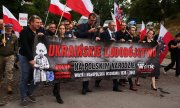
Historical dispute between Poland and Ukraine
Ukrainian President Volodymyr Zelensky has signed a decree giving a Ukrainian army unit the honorary title "Heroes of the UPA". However, in Poland the nationalist Ukrainska Povstanska Armiia (UPA) or Ukrainian Insurgent Army is notorious for the mass murder of civilians during WW II. Polish President Karol Nawrocki and his predecessor Lech Wałęsa are now calling for Zelensky to be stripped of the Order of the White Eagle, Poland's highest state honour, which he was awarded in 2023. Can the rift be bridged?
German-Polish reconciliation as a model
Gazeta Wyborcza hopes for strong conciliating gestures:
“One would hope that relations with Ukraine would be shaped in accordance with the principle formulated by the Polish bishops 61 years ago. On 18 November 1965, towards the end of the landmark Second Vatican Council, Polish Catholic dignitaries approached the German bishops and presented them with a letter containing the historic phrase: 'We extend our hands to you, seated here in the pews of the Council now drawing to a close; we forgive and ask for forgiveness.' ... The words of the Polish bishops' message from 1965 have been paraphrased on numerous occasions in Polish-Ukrainian relations. They must be repeated for as long as necessary.”
Tusk must show greater commitment to his allies
The Polish prime minister needs to put a quick end to the debate over the Order of the White Eagle sparked by President Nawrocki, the Süddeutsche Zeitung recommends:
“Nawrocki wants to escalate the situation, and Tusk all too often allows his domestic opponents to lead him by the nose. Since Nawrocki also counts Germany among Poland's enemies, Tusk is refraining from appearing alongside German politicians or participating in joint military projects. Yet he and his party have poll ratings of which his counterparts in Berlin, London and Paris can only dream. If Tusk wants to be taken more seriously there, he must clearly demonstrate his commitment at home to the allies whose attention and trust he demands: Ukraine and also Germany.”
Kyiv must put up with criticism too
Too much should not be made of the tensions as there are more pressing issues right now, Rzeczpospolita urges:
“Poland should support Ukraine to ensure that Zelensky's administration and not the members of the UPA, who have blood on their hands, are seen as the true heroes in the fight for independence and freedom. It must be possible to criticise Zelensky, as well as Ukraine and the Ukrainian people. ... Morally, we must not allow ourselves to be blackmailed. But there is a time and a place for everything.”
Tactical alliance shatters against wall of contradictions
Izvestia sees the historical dispute as an obstacle to Ukraine's European integration:
“There was an immediate barrage of harsh criticism [in Poland] directed at the Ukrainian leadership for its open glorification of 'killers of Poles' and 'UPA bandits'. In Warsaw, people are explicitly saying that integrating Ukraine into the European sphere is impossible under such circumstances. This latest dispute clearly demonstrates that a tactical alliance between two states based solely on short-term foreign policy considerations will inevitably shatter against the wall of unresolved historical and economic contradictions, which Warsaw is no longer willing to ignore.”
A dangerous logic
Historian and MP Volodymyr Viatrovych writes in a Facebook post republished by Obosrevatel:
“Some Polish politicians seek to portray the entire Ukrainian Insurgent Army as criminal. And according to this logic there can be no heroes in a criminal organisation. Ukraine cannot accept such an approach – and not just because it's historically unfounded but because condemning the Ukrainian Insurgent Army is just a small step away from condemning the Ukrainians' entire struggle for independence. And this is entirely in line with Russian policy, which aims to deny Ukrainians the right to their own state – not only in the past, but also today.”