
"Board of Peace" launched: to join or not to join?
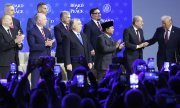
The founding document for the Board of Peace initiated by US President Donald Trump has been signed on the sidelines of the World Economic Forum in Davos. According to the charter, the Board's mission is to resolve conflicts in parallel to the United Nations. Hungary and Bulgaria are the only EU member states to have joined the controversial organisation so far. The media weigh in.
Buying time until it's blown over
European Pravda analyses the tactics of some European countries:
“In a situation where it is impossible to say either 'yes' or 'no' directly, a delaying tactic is often the best course of action. This is the approach taken by Lithuania, for example, which has expressed its willingness to join the Board of Peace as soon as the northern states reach a consensus on this issue (i.e. never). Poland is currently taking a similar approach, having decided to conduct a detailed review of whether the country's participation in the Board complies with constitutional requirements - in the hope that the review process will allow it to buy time until Donald Trump loses interest in this initiative. Ukraine also seems to have opted for a similar tactic.”
Bulgarian membership a bad move
Bulgaria's outgoing Prime Minister Rosen Zhelyazkov has signed the Board of Peace charter. That was beyond his purview, Club Z fumes:
“The former government's decision to join the Board without a parliamentary debate and contrary to EU policy must be discussed very seriously by everyone who cares about our country. If governments that have resigned can replace Bulgaria's interests with the personal interests of individual politicians, we could end up leaving the EU or find ourselves at war with our neighbours tomorrow, depending on the personal problems that those in power happen to be dealing with at the time!”
Shaping history as a small country
For the pro-government Magyar Nemzet, Hungary's accession is proof of its skilful foreign policy manoeuvring:
“It is clear that we will not only seek solutions within the European bloc. With the help of the Board of Peace, Hungary's international scope for action is expanding, opportunities for initial rapid responses are opening up - and at the same time we have the chance to be among those who shape history. This does not necessarily apply only to those who have large oil reserves and countless nuclear warheads, but also to those who can skilfully navigate a world of dangers.”
The UN's hands are tied
The United Nations has lost much influence in recent years, legal scholar Alina Dobre comments on Contributors:
“The problem with the UN, and about this President Donald Trump is right, is that it no longer functions as an international organisation in all its components. This is partly due to the veto power of the permanent members of the Security Council, which blocks measures aimed at restoring world order and thus deprives the organisation of its main means of enforcement at the international level: the deployment of peacekeeping forces to defuse conflicts. Since the occupation of Crimea, neither the UN nor the Security Council have taken any action whatsoever. Everything remains at the level of declarations, which are often blocked.”