
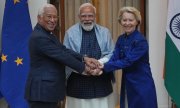
EU signs free trade agreement with India
The EU and India have concluded nearly 20 years of negotiations on a free trade agreement. Both sides had thus deepened the "partnership between the world's largest democracies", EU Commission President Ursula von der Leyen said in New Delhi. The agreement covers a market of nearly two billion people. Commentators highlight its strategic importance.
More geopolitical clout
The EU will benefit immensely from the deal with India, says the Salzburger Nachrichten:
“In the long term, the benefits and symbolic significance are likely to eclipse the Mercosur agreement. India is an interesting partner for many reasons: not only because the country is a huge market with one of the highest growth rates in the world, but also because working with the world's most populous country will automatically increase one's geopolitical clout. The pact could also help the EU to defend its values in an increasingly harsh environment.”
Europe is not doomed
Der Standard welcomes the trade agreements with India and Latin America:
“There is a narrative that right-wing and far-right parties in Europe are exploiting and that is now also being supported by the White House. It goes like this: the EU is heading for collapse. ... Through the EU deal with India and the finalised Mercosur agreement, Europe is finding new allies and new markets. At the same time, we are offering an alternative narrative to that pushed by Trump: cooperation can produce two winners. Stand up more resolutely to Europe's opponents, reach out to friends: this is how things can work out in this new world order.”
Soon also partners in spirit
The EU is ignoring India's democratic backsliding, political scientist Christophe Jaffrelot criticises in Le Monde:
“Although India is becoming increasingly illiberal, Europeans continue to regard it as 'the world's largest democracy'. ... Not only are religious minorities still victims of daily discrimination and violence, not only has civil society been brought into line by the authorities, but convincing evidence of electoral fraud has also been presented. ... The EU is remaining silent on these issues not only because realpolitik is perhaps becoming the norm in order to resist Trump, but also because the ideological focus of Europe and the EU Parliament is shifting. ... In the long term, the rapprochement between the EU and India could also be based on ideological common ground.”
Time for post-colonial humility
Despite all the differences, Europe cannot ignore India, the Süddeutsche Zeitung stresses:
“Europe's democrats should have no illusions about this. Prime Minister Narendra Modi's government pursues an India-first policy which it sells as 'cultural nationalism' based on traditional Hindu values. ... Modi and President Vladimir Putin get on well. India buys Putin's cheap oil. And in September, 65 Indian soldiers took part in a military exercise in Russia. Europeans may not like all this, but getting up in arms about it won't help now. ... Lecturing and post-colonial arrogance would be counterproductive. India is a giant that is struggling to stand up right now. It won't let anyone belittle it anymore.”
Romania could be a bridgehead
Ziarul Financiar sees major opportunities:
“Indian companies from the renewable energy, pharmaceutical, IT and electronics sectors are already active in Ukraine and Moldova. Neighbouring Romania could become a bridgehead via which Indian and Romanian companies help to build up the two countries. So there is no need for 100 Romanian companies to set up shop in New Delhi; it will be enough for 100 Indian companies to come to the port city of Constanța or the cities along the A7 motorway. Romania's economic strategy is clear and simple: establish a partnership with India so that by 2030 we become the gateway and bridgehead for India in Europe. We can do it!”