
Is Canada's PM Europe's best defender?
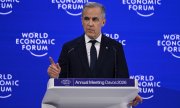
At the World Economic Forum in Davos, a speech by Canadian Prime Minister Mark Carney attracted particular attention when he declared the end of the old rules-based order and the "beginning of a harsh reality". Carney explained that middle powers must join forces to act together against threats from the major powers. Commentators also see the need to act.
A wake-up call
Finally, someone is talking turkey and opening Europe's eyes, the Irish Examiner rejoices:
“Mark Carney, whose 2,100-word deconstruction in Davos of the actions and statements of US president Donald Trump may prove to be the most influential moment in the tenure of the 47th leader of the US; when countries which imagined they were allies in the cause of democracy collectively recognised they were regarded as vassals. ... It is long overdue that the 'middle powers' heed the wake-up call. As Carney said, those that are not at the table are on the menu. Greenland must not be the last instance where we act swift and fast against bullies.”
Decoupling from US inevitable
If nothing else, Davos has highlighted the need for Europe to go its own way, Hospodářské noviny argues:
“Canadian Prime Minister Mark Carney's speech in Davos, which in the eyes of European liberals eclipsed Trump's blabber, offers a roadmap for the future. Carney spoke of breaking away from America and creating a new cooperation between middle powers so that the major powers can no longer do whatever they want with them. It is not and will not be easy, but it is the path that Europe – whether under the banner of the EU or some other entity – must take in order to preserve not only its dignity, but above all the security and prosperity of its own citizens.”
Not suitable for a complex continent
Carney's ideas cannot be easily transferred to Europe, Corriere della Sera interjects:
“Europe is probably the region of the world that will be most disadvantaged by the American government's new strategic doctrine (and concrete measures). Ideas and proposals in response to this are welcome. However Europe is different from Canada. It is potentially much stronger, but remains weak because its power is complex (many states of different sizes and resources) and changeable (it varies depending on the context). In the coalition of the willing, for example, Europe is little more than a territorial expression. There are EU and non-EU countries. ... The club of the willing consists of sovereign states.”
How to deal with a barbaric gang
Íñigo Domínguez, El País correspondent in Rome, sees Mark Carney as a new spokesperson for the EU:
“Europe finally has a leader. It's a shame he's Canadian, but nobody's perfect. I'm talking about Mark Carney. ... A North American Draghi, a liberal, pragmatic, decent and sensible right-winger. ... When you listen to him, you wonder why no one said this before; he talks with common sense about how to deal with Trump and his barbaric gang. ... We need a left that gives us hope, but even more urgently we need an honest right that no longer goes along with this dangerous nonsense. ... I wonder if everyone will finally understand or if it will take even worse barbarities for them to see this.”
This is about more than geography
Mark Carney has highlighted that Europe is defined not by borders but by values, Ukrainian journalist Vitaly Portnikov writes on Facebook:
“It may seem surprising that it is a non-European politician who has presented the concept for responding to the return of imperialism in its worst form. But that would be an oversimplification. First, Carney was not only head of the Bank of Canada, but also of the Bank of England. Secondly, 'Europe' is not just a geographical entity but also a system of values. And from this perspective, Canada, Greenland, Australia and New Zealand – geographically far removed from Europe – are all European countries. By contrast Russia, which covers a large part of the continent, has always had only an indirect relationship with Europe.”
EU can't "tell it like it is" yet
Expresso welcomes Carney's proposal to create a networked coalition of middle powers without the US:
“The Carney doctrine has sparked intense debate. Even if it succeeds, the process of Canada's adjustment to what we might call the 'great rupture' will be difficult and protracted. Carney has the merit of 'telling it like it is'. In Portugal and many other European countries, we are not yet able to do this. The problem is not just the lack of political options and our dilemmas in the areas of defence and the economy, but also the long process of strategic infantilisation that we have accepted out of convenience during the period of hegemonic stability in Europe guaranteed by the US.”