
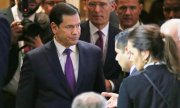
Munich Conference: Rubio's message to partners
This year's Munich Security Conference was dominated by the tense transatlantic relations. To what extent can Europe count on the US as a Nato partner in the Trump era? Is the US still an ally, or is it now an adversary? Can the continent guarantee its own security? In the search for answers, all eyes were on US Secretary of State Marco Rubio.
Birth of a Europe that can defend itself
Polityka already sees a new course taking shape:
“In Munich, European leaders presented the Mega vision – Make Europe Great Again – as the only way for Europe to preserve its autonomy in the face of a changing world order. The friendly attitude of the Washington representative was welcomed, but without any great illusions. The course for strengthening Europe's defence capabilities has long been set and is now widely accepted, although it is being implemented at different speeds by different players. In the language of the debates of recent decades, this can be described as a 'multi-speed defence union'.”
Prettily packaged power politics
Der Spiegel is baffled as to why the Europeans are relieved after Rubio's appearance:
“How naive can you be? In Munich, Rubio resembled the assistant to a torturer who hands the delinquent a glass of water after he has been forced to walk over hot coals. Rubio didn't budge even a millimetre from Trump's policies. He defended Trump's tariff policy and imperialism. He unreservedly advocated policies geared solely towards national interests and called the 'rules-based world order' an overused term. ... What distinguishes Rubio from Trump and Vance is his ability to cloak ruthless power politics in polished language.”
Europe is finding its voice
For NRC, Chancellor Merz's speech at the Munich Security Conference marks the emergence of a new, stronger Europe:
“Merz's confident words showed that Europe is gradually finding its voice in the tough political confrontation with Trump's America. This voice is sober, realistic, free of flattery – and imbued with the urgent message that Europe must hurry to strengthen its own position as a geopolitical factor. Germany is ready to assume 'a leading role' in a partnership, as Merz cautiously put it. 'Without hegemonic fantasies', he added for good measure. ... To achieve a strong Europe, Europeans must overcome old fears.”
Washington has woken us up
Thanks to Trump, Europe has become more independent, Iltalehti writes:
“With regard to Europe and European security, the US message was clear. European countries should take responsibility for their own affairs and their own security. The Americans played a tough game, their approach was erratic, to say the least, and their style aggressive. Trump's statements in particular often hovered on the limit between confusion and madness, generally leaning more towards madness. From a European perspective, however, it can be said that Trump's bluster has also done a lot of good. Europe has finally woken up and realised that we have to take care of our own affairs.”
Arm or die
Europe still harbours too many illusions about its security, Espreso laments:
“No one has as much to do with Russia as we do, so there is a distorted perception of the danger. ... In a sense, Europe's behaviour resembles our own before February 2022, when many ignored the real danger and believed that the Russians, for the most part, were not suicidal. Now that there is a real danger of a transatlantic 'divorce', Europe is clinging to certain illusions. But it doesn't matter who announces the 'end of this marriage', be it the blunt Vance or the more diplomatic Rubio. It is no longer possible to live as we did before, and whatever happens, the thesis 'arm yourself or die' is more real than ever.”