
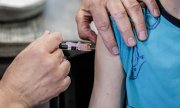
Why is measles making a comeback?
Several European countries which had been declared "measles-free" by the World Health Organisation (WHO), including Spain, the UK and Austria, have recently lost that status following major outbreaks in the last year. According to the WHO and UNICEF, a vaccination rate of 95 percent is needed to prevent the virus from spreading. Commentators in several countries look at vaccination rates and scepticism.
Not a harmless disease
El Periódico de Catalunya appeals to readers:
“The resurgence of measles shows that one of the most solid public health consensuses of recent decades – vaccination – has been shaken. ... Measles is not a mild disease. It is a highly contagious virus that can cause serious complications and even death. There is no specific treatment. ... Vaccination is not compulsory. But nor is it an entirely individual decision, it is an act of social responsibility. It protects those who are vaccinated and those who cannot be vaccinated due to their age or medical conditions. ... In times of unrest and confusion, we should remember that the evidence is clear: immunisation is prevention.”
No all-clear in Ireland either
Scepticism about vaccines is also jeopardising herd immunity in Ireland, the Irish Examiner explains:
“Data from the last three months of 2025 showed that MMR vaccine uptake among children aged 24 months was 87.6 percent - that is below the WHO target of 95 percent uptake required to prevent outbreaks. ... Misinformation and fake news are now being cited by Unicef and WHO as fuelling vaccine hesitancy and the consequent persistence of measles. ... The conditions that led to the resurgence of this deadly disease in recent years remain and must be dealt with. ... These are preventable deaths and illnesses. We should not wait until there is an outbreak on our doorstep to have our children vaccinated.”
Prevention through education and prosperity
The UK must quickly boost its low vaccination rates and at the same time address the causes, warns The Spectator:
“Studies show that vaccine uptake is lower where there is poverty, where there is a lack of education, and where there is unemployment. NHS England found it is lowest amongst black people and those from Pakistan and Bangladesh. These are risk factors, but they are modifiable. ... If it seems ambitious to suggest the state should try and increase vaccine uptake by creating wealth, and jobs, a culture of education, and the shared values that allow for trust in science, it's important to note that these are what count, and not just for vaccines.”