
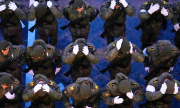
9 May: Will Kyiv attack the parade in Moscow?
Uncertainty hangs over Russia's annual military parade held in Moscow on 9 May to celebrate the victory over Nazi Germany. In view of Ukraine's increasingly successful drone strikes across Russia's territory, the parade is taking place without its usual display of military hardware. Commentators see this as a sign of vulnerability and draw very different conclusions.
Target the core of Putinism
Latvijas Avīze argues that a successful Ukrainian attack on 9 May would have great symbolic value:
“It would be less about causing material damage and more about undermining the whole idea of Russian greatness that has been built up around this date over the years. Ideologically, of course, the significance of this day remains unchanged – it has been and will continue to be the core element of Putinism.”
Too high a price to pay for disruption
The taz's Kyiv correspondent Bernhard Clasen advises Ukraine against drone attacks:
“Russia will use such Ukrainian attacks to portray the Ukrainian leadership as fascists seeking to diminish remembrance of the victory over Hitler. What is more, only a few drones will be able to get through. The others will be shot down. And drones shot down over residential areas could cause civilian deaths. Unfortunately, the threat that the centre of Kyiv will be bombarded with missiles if Ukraine attacks Russia on 8 or 9 May must also be taken seriously. Why risk the lives of Kyiv's civilians? That's a high price to pay to steal the limelight from Putin's parade.”
Strikes against Kyiv a foregone conclusion
Military and political expert Olexander Kovalenko writes on Facebook:
“In Russia, the most unrestrained propagandists are being sent onto the stage to issue threats against Ukraine in a bid to ensure calm ahead of the parade on 9 May. Maria Zakharova [Spokesperson for the Russian Foreign Ministry] has threatened to carry out a strike against Kyiv, and [TV presenter Olga] Skabeyeva has explained how it is to be carried out. Yet they all fail to mention that such an attack has long been in preparation and will take place after 9 May anyway – regardless of whether Ukraine adheres to the pseudo-ceasefire declared by Russia.”
A good opportunity to divide Russia
In a Telegram post republished by Echo, political scientist Abbas Galliamov speculates that Ukraine might exploit the fact that Russia has concentrated its air defences around Moscow:
“The Ukrainians will drive a wedge between Moscow and the Russian regions by emphasising that the defence of the capital is being carried out at their expense. It would be odd if they didn't do this. It is one of the Putin regime's greatest vulnerabilities. The only effective defence against this line of attack would be for Putin to make regular visits to the provinces and announce the delivery of new air defence systems to each region he visits. But in my opinion, the Russian president is not in a position to do this.”
Schadenfreude not a good idea
Die Weltwoche warns:
“The same headlines are currently appearing everywhere: Vladimir Putin is in trouble, he is no longer the 'strong man' he always wanted to be and Russia is in danger of losing the war in Ukraine militarily. Then there's the malicious schadenfreude of certain journalists who are revelling in the fuss over the victory parades in Moscow. But we should look at this from a different perspective: if these reports are true, then things are going to get really dangerous. It is a policy of suicidal madness to corner a nuclear power like Russia in this way. Anyone who thinks a Russian defeat on the battlefield would be a welcome prospect is misjudging the strategic reality. A nuclear power that feels its existence is under threat will be inclined to deploy more powerful weapons.”
Admission of vulnerability
The Frankfurter Allgemeine Zeitung notes a shift:
“Last year, the Russian regime acted out of a demonstrative sense of its own strength. Now it clearly finds itself on the defensive. The fact that the Kremlin is refraining from parading military equipment across Red Square due to the threat of Ukrainian drone attacks, and is shutting down mobile internet across half the country for 'Victory Day', is a remarkable admission of vulnerability.”
Attack would be fully justified
Zelensky would be fully within his rights if he launched an attack on the Victory Day parade, says Gazeta Wyborcza:
“Vladimir Putin agreed with Donald Trump, but not with Volodymyr Zelensky, that a temporary ceasefire should be in place on 9 May, when he will be standing out in the open [at the Victory Day parade]. The Ukrainian president responded by announcing a 'ceasefire regime' between Wednesday and Sunday. Moscow responded to this in its own way, with utter arrogance, attacking Ukraine with drones and glide bombs on Wednesday. It thus gave Zelenskyy every moral right to fulfil his promise that Ukraine would not allow military equipment to be on display at this year's Victory Day parade, which will be nothing more than a march by military academy cadets.”
The momentum is on Ukraine’s side
According to the Tages-Anzeiger, Kyiv is gaining the upper hand over Moscow:
“No significant military breakthroughs are to be expected on either side in Russia's war against Ukraine. But Ukraine is still holding out; it has even made minor territorial gains recently, and – inspired by the Iran war – it is attacking oil facilities and showering Russia with black rain. The collapse of Ukraine, which has so often been predicted, may never have been less likely. And now Zelensky has not only put Putin under pressure with his unilaterally declared, indefinite ceasefire, but has even forced him to scale down his beloved parade marking the victory over Nazi Germany. Whatever happens in the coming months, the momentum is currently on Ukraine’s side.”
A religion of war
In the run-up to the celebrations, the pro-Kremlin organisation All-Russia People's Front is bringing an 'Eternal Flame' to numerous Russian cities to light torches at war memorials. The Moscow Times detects religious overtones:
“This new religion that the current Russian rulers and the 'People's Front' are attempting to create is nothing other than the religion of Ares, also known as Mars, the god of war. All these parades, 'immortal regiments', 'prayers for victory' and 'military churches' are nothing but a religion of war. And the 'fire of remembrance', which followers of the new Russian faith are eagerly and elaborately spreading throughout the country, and even around the world, is the fire of war.”
Moscow's security no longer guaranteed
Political scientist Ihor Petrenko writes in a Facebook post picked up by Glavkom:
“This week the Institute for the Study of War highlighted an important point: for the first time since the beginning of the war, Putin personally commented on the attacks on Russian oil refineries. Moscow had previously ignored such incidents or denied them because they undermine the propagandist narrative. Now a reaction was unavoidable. ... Last year in the run up to 9 May around 280 air defence systems were sent to Moscow, some from remote regions. This year, however, now that Ukrainian drones are regularly hitting their targets more than 1,500 km inside the border, even this no longer offers a guarantee.”
Putin's got the jitters
MP Mykola Knyazhizkyi writes on Facebook:
“In 2023, the parade took place just a few days after drone attacks on the Kremlin. This parade is famous for including a T-34 tank that was rolled out of a museum as well as for using the presidents of Tajikistan, Turkmenistan and several other countries as a kind of 'human shield'. Because the whole of Russia – from the Baltic Sea to the Urals – is currently in turmoil, it's unlikely that they will manage to find any foreign leader willing to provide 'cover' for Putin with their presence. All hopes rest on Fico. This is why Putin rang Trump – so that he will act as a guarantor of security and ensure that Ukraine refrains from attacking Russia for a certain period.”
Hard to fathom Fico's motivation
Új Szó speculates on why the Slovak prime minister is intent on travelling to Moscow:
“It's hard to understand why Robert Fico is so determined to go to Moscow or what his motivation might be. Is he really that keen to appear at the parade or stand in the VIP box alongside a handful of Central Asian dictators? Or is this in fact a phase of quiet economic networking in which the PM will be negotiating investments behind the scenes? Could it be nothing more than a gesture towards the pro-Russian section of Slovak society? Or is it actually a matter of principle which makes it vital for the Slovak premier to show his respect for the country's liberation [in World War II]?”