
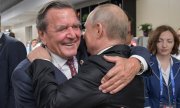
Kremlin proposes Schröder as mediator
Russian President Vladimir Putin has suggested that his friend, former German Chancellor Gerhard Schröder, could act as a mediator in the war between Russia and Ukraine. In an address after Saturday's military parade in Moscow, Putin said he could envisage the former SPD leader acting as an intermediary in talks with the European side. Commentators debate whether this is a good idea.
He has the right track record
Der Freitag approves of the idea:
“What a diplomatic coup it would be if the Europeans were suddenly to present their own negotiator – and then for it to be Gerhard Schröder. ... At the start of 2003 he refused to fulfil President George W. Bush's expectation that Germany help the US attack Iraq as part of a 'coalition of the willing'. ... As a head of government in the heart of Europe, Schröder once stopped the entire continent from becoming a lackey – and thus a hostage – of an overconfident conqueror. One could pay him belated tribute by entrusting him with a mandate to act as peacemaker and thus display the much-vaunted European self-assurance.”
Putin's pal would tip the scales
With Gerhard Schröder as negotiator there will be no peace deal that is fair for Ukraine, warns The Times:
“Some Germans are content that Germany should be at the negotiating table on Ukraine rather than depending on President Trump's envoys. If Ukraine's European future is to be discussed, they reason, let it be with the help of someone who understands Europe and Russia. They have short memories. ... In March 2022 Mr Schröder posed as a peacemaker, and flopped. As Kaja Kallas, Europe's foreign policy chief, puts it: with Mr Schröder as negotiator, the Kremlin's man would be sitting on both sides of the table.”
An intermediary must see both sides
Die Weltwoche vehemently disagrees with Kaja Kallas:
“The German 'would be sitting on both sides of the table', she objected. Is that supposed to be a bad thing? Sitting on both sides means understanding both sides – the best prerequisite for mediation. Switzerland used to be really good at that. Kallas thinks this is bad – and has thus revealed what she really wants: a peace dictated by the West that humiliates Russia. By doing so she has unwittingly confirmed one thing: Schröder would be the best man for the job.”
Steinmeier is the man for the job
Népszava favours the alternative proposal put forward by Berlin to appoint German President Frank-Walter Steinmeier as intermediary:
“Moscow can't simply brush this proposal aside. On the one hand, because he is Germany's highly respected head of state. On the other hand, because although Steinmeier has repeatedly and strongly condemned Moscow for its war of aggression, he sought to maintain very good relations with Russia during his time as foreign minister. In fact, he was later accused by some of Russophilia for this very reason. This is precisely why the German idea is so ingenious: if the Russian leadership rejects it, it would prove that even though it seems increasingly unlikely that Russia will achieve its objectives in Ukraine, it still wants only war rather than reconciliation.”
A token offer designed to stir up trouble
The Süddeutsche Zeitung speculates on Putin's motives with his proposal:
“Putin wants to stir up trouble in Europe by pretending that he is open to talks. This is nothing new. It's like him pointing out that 'this matter' – by which he means the war – 'is nearing its end'. These words, this proposal, are the very opposite of serious, results-oriented diplomacy. And this time it's particularly easy to see through. Is there perhaps a note of desperation here? Putin certainly has every reason to make token offers. Ukraine's military position hasn't been this strong in a long time.”
Hardly a neutral broker
Frankfurter Allgemeine Zeitung explains why Gerhard Schröder would not be a suitable mediator:
“The former German chancellor has long been on Russia's payroll. So he wouldn't be a neutral broker either between Kyiv and Moscow or between Europe and Moscow. No one in Ukraine would trust him, and nor should anyone in Europe. Schröder is Putin's man: the fact that, after leaving office, he chose to accept (substantial) sums of money from Russia disqualifies him as a diplomat today.”
Right to question sincerity
Putin may say he is ready for talks, but as La Repubblica explains, the EU is right not to take him by his word:
“[Putin's] message has raised many doubts and concerns in Brussels. ... The EU's institutional leaders do not believe that this is 'the right moment' to talk with Putin. It is clear that very few people in the capitals of the Old Continent are convinced that the Russian leader is sincere. In fact, the most widely held view is that this move is primarily intended to buy time at a moment of extreme difficulty, both in terms of domestic politics and on the military front in Ukraine.”