
Victory parade in Moscow: how to read Putin's words?
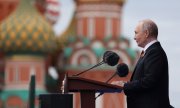
Russia held its traditional military parade on 9 May - during a three-day ceasefire - to celebrate the victory over Nazi Germany. President Vladimir Putin gave a speech explaining that the Russian army was fighting "aggressive", Nato-backed powers in Ukraine. At the press conference afterwards, however, he said he thought that 'the matter' was coming to an end.
A dying star
Political scientist Viktor Shlintshak writes on Facebook:
“Putin wanted to flex his muscles again but spent the week seeking security. He wanted to demonstrate control, but Russia's most important public holiday was entirely dependent on decisions made by Ukraine. He wanted to demonstrate that he enjoyed international support, but everyone could see that the leaders lined up beside him were those whose dependencies left them no choice but to be there. And finally, Putin wanted to present the army of victors. Instead, he presented an open-air liturgy that smacked not of greatness, but of a kind of necrophilia. … Putin's star is dying.”
More like a secret service operation
Political scientist Nikolai Mitrochin warns on Facebook against underestimating Russia's military might:
“These persistent claims that Putin demonstrated his weakness with the parade and now lacks military hardware don't quite add up, given that the latest Russian tanks and other armoured vehicles have disappeared from the battlefield, but are still being produced, repaired and modernised. There have been no reports of production being halted or scaled back. ... The parade was more in line with 'Chekist' [secret service] traditions – a kind of 'special operation' the meaning and purpose of which we will learn about later.”
Now that the enemy has a name
Putin's tone has fundamentally changed, La Stampa notes:
“It's 'Mr. Zelensky' now, instead of 'the leader of a neo-Nazi clique', 'the leader of the illegitimate regime in Kyiv', 'neo-Nazi' or 'comedian'. Given Vladimir Putin's nigh on superstitious habit of never calling his most hated enemies by their names, the decision to do just that – in combination with the idea to set up a personal meeting with him – could signify a change of mood in Moscow, almost more so than the promise of a war that 'is drawing to a close'.”
Time running out for Kremlin leader
The Kremlin leader is increasingly losing support within Russian society, economist Vladislav Inozemtsev emphasises in Kurier:
“Given the duration of the Russia-Ukraine war – comparable to the First or Second World War – we shouldn't say that Ukraine 'has no cards left to play' or has been 'militarily defeated'. The loser is easy to spot, and it is Putin's Russia. What happens next may come as a surprise, but many signs point to Moscow's inevitable failure. Even if the Russian economy is still strong enough to finance the war effort, neither the Russian people nor the political elites are prepared to sacrifice themselves for the country's ageing 'leader' and his delusional ambitions. Putin is running out of time.”
When only money matters
For Kauppalehti, it is only a matter of time before the elite in Russia rebels:
“The uncertain economic situation is putting the spotlight on the decision-makers. Particularly because of the setbacks that are happening at the same time on the front in Ukraine. In April Russia lost more territory than it conquered for the first time. And Putin's approval ratings are at their lowest since the start of the war, according to the most recent polls. But the population is intimidated and compliant. The key question is how the frustration will manifest among the power elite. In a system that is corrupt to the core, money is the only thing that matters – and when the cash flow runs dry, there will be unrest.”
Europe not overly pleased with Fico
Sme criticises the Slovak prime minister's recent trip to Moscow:
“It is rather ironic that Robert Fico believes his European partners would say: 'Oh, our "ally" Fico was in Moscow on Victory Day, attended the reception, shook hands with autocrats, negotiated with Putin – although he wasn't on the podium during the parade – then laid down a wreath at the Tomb of the Unknown Soldier – not at the same time as Lukashenko and that lot, mind. We appreciate the difference, and that's all fine.' Yes, they see Fico's 'differences' and probably take the same view of them as they would of the excuses of a teenager caught stealing loose change from his parents' wallet.”