
Trump to visit Xi: rapprochement between US and China?
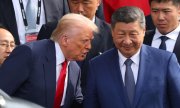
After postponing his trip due to the Iran conflict, US President Donald Trump is now set to travel to Beijing for a state visit on Wednesday. His talks with Chinese President and party leader Xi Jinping are likely to focus on the issues of Iran and Taiwan, as well as trade and artificial intelligence. The media look at what divides the two superpowers, but also what they have in common.
Cooperate instead of waging virtual war
The world is facing fundamental challenges that call for cooperation between the major powers, writes Libération:
“On the one hand, we have climate change and its consequences – wars over water, increasing migration flows and pandemics. On the other hand, there's the AI revolution. … Both could potentially be catastrophic. No single power can tackle them alone. … International cooperation is essential to prevent the worst from happening. … Yet China and the United States are engaged in a technological arms race over AI and space – the first clashes in a virtual war. ... It's hard to imagine cooperation between the unpredictable US, which is trying to preserve its waning hegemony, and a China that wants to restore the 'Middle Kingdom'.”
Gradual shift in dominance
While the US flounders, China is systematically improving its global standing, writes Postimees:
“China does not need to destroy America directly. It can simply stand by as the US fragments its own power. While Washington has to react to new crises day after day, Beijing is patiently developing infrastructure for the next century. History teaches us that great powers fail not so much when they are weak, but when they can no longer distinguish between what is important and what is not. Perhaps the most significant question in today's world is this: is America still aware that its main adversary is not in Tehran, but in Beijing?”
The next crucial strait
Economics expert Alicia García Herrero explains the global dimension of the Taiwan issue in El País:
“The Taiwan Strait is the lifeline through which the most important resource for artificial intelligence flows. ... Taiwan produces over 90 percent of the world's most advanced semiconductors – the chips that power AI data centres, cutting-edge weapons systems and the digital infrastructure of Western democracies. A crisis in the Taiwan Strait would have consequences comparable to the Strait of Hormuz blockade – or worse. ... Trump's negotiations with Xi Jinping will not only determine the future of an island with 23 million inhabitants, but also the balance of power for decades to come.”
Bad news when anti-democrats unite
NRC hopes that the summit will not lead to closer ties:
“The better Trump and Xi get on, the higher the price the rest of the world will have to pay. And conversely, the fewer tangible agreements the two power blocs reach, the better it will be for the rest of the world. If the two leaders of the most powerful countries don't (or no longer) recognise the fundamental principles of a democratic constitutional state, then the rest of the world has a duty to uphold those principles. Reliability, predictability and legal systems that everyone adheres to have helped the world to move forward in the last centuries.”