
Ukraine strikes St. Petersburg: bitter pill for Putin?
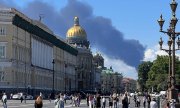
This year's St. Petersburg International Economic Forum (Spief) opened on Wednesday. Shortly beforehand, however, Ukrainian drones set fire to the oil terminal in the port, causing thick plumes of smoke to billow over the city. Commentators examine the significance of the forum – once dubbed the "Russian Davos" – and the impact of Ukraine's attacks on Russia.
A hunted man in his own country
Politician Andrei Pivovarov writes on Facebook:
“An airstrike on May 9 [targeting the military parade in Moscow] was only averted thanks to Trump's intervention. Putin wants to impress the foreign dignitaries at the forum, but St. Petersburg greets the dawn against a backdrop of burning ruins. Thanks to new drone technologies and the disastrous performance of Russian air defences, Ukraine can pose a threat to virtually anywhere in the European part of Russia. Putin's presence at any major event now is not just the appearance of the head of state, but also carries the risk of a new drone attack. He is turning from a lucky leader into a harbinger of doom.”
Potemkin village
There's a huge gap between what the Spief aspires to be and what it really is, Cotidianul points out:
“Putin needs the event to convey three messages. He wants to show the domestic audience that the economy is holding up – and the West that the sanctions against Russia are not working. Non-Western partners are presented with an invincible Russia – a state that remains an important market and a useful ally. The problem is that there's a huge gap between the message and the reality. While the Kremlin can fill the halls with delegations, announce bilateral talks and speak of a new global architecture, it cannot hide the fact that Russia has failed to compensate for the loss of Western capital, Western technology, and access to international financial markets.”
Russia's size is now its weakness
Putin's empire is under immense pressure, notes Svenska Dagbladet:
“Russia's vast size once made it virtually unconquerable. But in the age of innovative long-range precision weapons, Putin now has to face the fact that the sheer size of his country makes it very difficult to defend. ... At the same time, the situation for Russia is deteriorating rapidly, economically and militarily. There are still fluctuations in the course of the war, but Ukraine's pace of innovation gives it technological superiority. The Russians may be able to counter the threat for now, but in the long run they are lagging behind both in terms of innovation and the economy.”
End of an illusion
The attacks are more than a symbolic humiliation for Putin, explains Corriere della Sera:
“St. Petersburg is dear to his heart. ... That his city is now under attack is not merely a humiliating and symbolic setback for Vladimir Putin. It is also strategic relevant. He, who always wanted to keep Moscow and St. Petersburg in a protective bubble by ensuring that war was kept far in the distance, now has to accept that it has arrived on his doorstep. And the fairytale about the 'special operation' has been shown to be pure illusion.”
German business is burning no bridges
wPolityce.pl shines a light on the German business community representatives present at the forum:
“The head of the German-Russian Chamber of Commerce, who is doing remarkably well despite the ongoing war in Ukraine, now explains that the goal is to 'maintain the economic bridge to Russia', just as others would do. Matthias Schepp also adds that at stake is 'the protection of over 100 billion euros in German assets in the country' – in other words, a great deal of money. His words not only prove that some German companies have remained in Russia, but also sends a clear signal that a genuine resumption of cooperation may be possible very soon.”
Motley gathering of paid stooges
In a Telegram post picked up by Echo, film director Alexander Rodnyansky pokes fun at the 'illustrious' participants at the St. Petersburg International Economic Forum:
“The Forum is Russia's most important 'showcase'. A vivid demonstration for foreigners that everything in the country is just tickety boo: it's business as usual, there are no problems at all, and there is certainly no war. Nor is there any mention of 'international isolation'. To this end, foreigners known for their dubious reputations are flown in to St. Petersburg to gush over Vladimir Putin in exchange for a generous fee. ... A fascinating 'economic forum' is taking shape: conspiracy theorists, rapists, and antisemites will be listening to Putin's speech. Against the backdrop of burning oil terminals.”