
Ukraine summit in London: what was achieved?
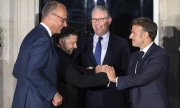
At their meeting in London, the leaders of the UK, France, Germany and Ukraine have called on Russian President Vladimir Putin to agree to an immediate ceasefire and to enter into negotiations to bring the war to an end. In a shared declaration Keir Starmer, Emmanuel Macron, Friedrich Merz and Volodymyr Zelensky called for the 'active' involvement of Europe and the US in peace talks.
Zelensky no longer just a supplicant
The London summit marks a turning point, La Repubblica believes:
“For the first time, Moscow is clearly having difficulties on the military front. This means that the 'Club of the Willing' can now seize the initiative and attempt to take over the US's role as mediator. … What's more, Zelensky's blitz attack on St. Petersburg using long-range drones, which coincided with the 'Russian Davos', shows that Putin is not even capable of defending his own city. ... As a result, the situation has shifted and for the first time, Zelensky appears to have the strategic upper hand. So he is coming to London not just to ask for help, but above all to propose solutions.”
Kyiv now an indispensable ally
Ukraine is becoming increasingly important as a European security partner, observes The Independent:
“The Ukrainians have the biggest army of any European nation, and have become global leaders in the revolution in warfare wrought by drone and anti-drone technology (and soon, by AI). ... the Europeans have much to learn from Ukraine, and the military relationship is now a two-way street. ... As the UK continues to build a new security partnership with Europe – one that, out of necessity, must for now work beyond the existing structures of the European Union – it is clear that Ukraine is no longer a supplicant, but a military force essential to this task. It is an indispensable ally, and a welcome one.”
Close ranks in defence
Europe must do more to support Ukraine's air defence, De Volkskrant demands:
“Particularly now that doubts are growing in Russia, Europe can and must do more to highlight the madness of Putin's warmongering. As long as European parts are still making their way into Russian missiles, as long as Irish aluminium is being delivered to the Russian war machine, and as long as European leaders refuse to make the protection of Ukrainian airspace a priority, they are deluding themselves and their citizens. Because minimising risks for Ukraine also means filling the gaps in our own defence.”