
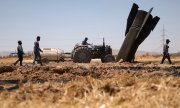
100 days of the Iran war: Gordian knot in the Mideast?
Last Sunday marked the 100th day of the US and Israel's war against Iran. While the initially fierce military confrontations in the Persian Gulf have subsided and the blockade in the Strait of Hormuz has become the central issue, Lebanon is now at the centre of events due to the conflict between Israel and Hezbollah.
Lebanon a pawn in a bloody game
Der Standard analyses the situation:
“Trump appears willing to make concessions on many points. But on the issue of Hezbollah's survival – a key Iranian demand – he can't deliver unless Netanyahu plays ball. ... It's not clear how long Netanyahu can withstand the pressure from the White House. After all, US support is the main guarantee of Israel's security. And with its missile attack on Israel, Iran has further raised the stakes in this bloody game of poker: the message is that without a ceasefire in Lebanon the war with Iran will not end, and Trump's self-inflicted dilemma won't be resolved. The exchange of blows between Israel and Iran is likely to be over for the time being. But Lebanon will remain a pawn in the game between Tehran, Jerusalem and Washington.”
Closest allies causing big problems
Trump's influence over Netanyahu is waning, observes La Stampa:
“The president, who backed Israel in its offensive against Iran, now finds himself in the opposite position: he is no longer merely a political and military instigator of the escalation but a desperate mediator in a conflict that is taking on the hallmarks of a never-ending war. ... One promises a final agreement with Tehran, the other invokes self-defence. ... 'The Donald' can ring up, get angry, issue warnings. But because Washington didn't really rein Israel in when its military decisions made broader agreements more complicated, Netanyahu knows he can push the limits.”
False hopes of regime change
Tehran's opponents underestimated its resilience, HuffPost Greece observes:
“Iranian society may be oppressed, and – clearly – completely at odds with its regime. But this doesn't mean that it would readily accept external military pressure as a means of 'liberation' or 'rationalisation'. On the contrary: any attack from outside gives the ruling system the opportunity to equate its survival with that of the nation. This is a fact the West finds difficult to grasp. ... Social exhaustion doesn't automatically lead to pro-American political change. And the military defeat of a state doesn't necessarily mean the political defeat of its regime.”
Bitter lessons for Trump
The US president should never have started this war, the Irish Independent surmises:
“Trump is simply trying to avoid the grim reality that there is no easy way out of a conflict he should never have entered in the first place. All the options are bad, and Trump has no one but himself to blame. ... Trump is learning the same bitter lessons that previous presidents learnt in Vietnam, Iraq and Afghanistan, and that Vladimir Putin is now learning in Ukraine. War is not a targeting exercise, and the side with the most bombs does not necessarily win. Willpower counts more than weapons, and the ability to absorb punishment is ultimately more important than the ability to dole it out.”