
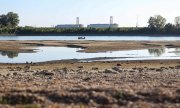
Drought forces nuclear plant shutdowns
Nuclear power generation has been scaled back or halted in several European countries due to low water levels in rivers and the resulting shortage of cooling water. In Romania, two reactors at the country's only nuclear power station, Cernavoda, have been shut down, and the country is now having to source electricity from its neighbours. In Hungary, too, the four reactors at the Paks power station have been shut down one by one, and the plant is no longer supplying electricity.
Despite knowing better
Válaszonline criticises the Hungarian government for ignoring the scientific community's warnings:
“There had long been forewarnings about the low water levels [in the Danube] that are now causing such a shocked reaction from the public and politicians. Yet nothing was done. ... The Danube is our best-studied river. And the published studies clearly show that expert knowledge about the risks was available, both in terms of the effects of climate change and the changes to the river bed. But despite this, the state allowed the Paks 2 project [for the construction of a new twin-reactor plant] to be based on a flow-through cooling system that uses river water, just as it had done before with Paks 1.”
Not the time for party politics
Former liberal politician Gábor Fodor comments in Index:
“Because natural disasters affect us all, regardless of our party affiliation, in such situations it would be wise for the opposition to set aside its criticism – which is normally its main role in Parliament – and make a clear offer to help tackle the crisis. For the government, the mature and appropriate course of action is to seek political cooperation with the opposition in order to find a solution as quickly as possible, rather than trying to pin the blame on previous governments.”
Romania lagging behind
Bucharest is now seeking to source electricity from Bulgaria, which has overtaken Romania in the energy sector, according to Deutsche Welle's Romanian service:
“Unlike Romania, Bulgaria – which used to have fewer energy projects – now apparently has more. ... Bulgaria is connected to the southeastern European grids and has an expanding nuclear programme at Kozloduy – a nuclear power station that currently covers 40 percent of the country's electricity needs. Its electricity is also generally cheaper than Romania's. Why? Because during the day, Romania sells its energy surplus at lower prices to the Bulgarians, who store it and then resell it to the Romanians in the evening at higher prices.”
Neglect of critical infrastructure
Drought is not the only factor behind Romania's energy crisis, writes energy expert Cosmin Gabriel Păcuraru on the blog platform Contributors:
“The energy crisis Romania currently experiencing is neither a coincidence nor solely the result of the drought or extreme temperatures. These phenomena merely bring to light the weaknesses that have built up over the years: delayed investments, abandoned projects, protracted maintenance work, a lack of new production capacity and the frequent failure of corporate management to deliver the expected results. … In a sector that is key to national security, this is unacceptable. Energy is not just a product, but a critical infrastructure.”
Heat pushing Paks to its limits
We need to think long and hard about the plans to upgrade the Hungarian nuclear plant Paks, writes Népszava:
“If Paks 2 were ever to be built, it would add a further 2,400 megawatts to current capacity. You don't need to be an expert to wonder, if the Danube's flow is not even able to safely cool a 2,000-megawatt reactor, what happens when the cooling system has to cope with a total reactor capacity of 4,400 megawatts?”