
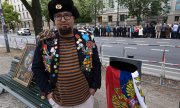
Russian cartoonist murdered in Poland
The Russian artist and dissident Semyon Skrepetsky was shot dead in broad daylight on a street in the eastern Polish city of Biała Podlaska on Monday. The authorities are searching for the perpetrator. Four days earlier, Skrepetsky, known for his satirical caricatures of Putin, Lukashenko and Stalin, had demonstrated outside the Russian embassy in Berlin.
An act of state terrorism
The Kremlin is responsible for this, Rzeczpospolita is convinced:
“It doesn't matter whether this crime (five shots fired at point blank to the head and chest – a public execution in broad daylight) was carried out by Chechens, Belarusians, Russians or mercenaries from the Russian-speaking part of Ukraine. There can be no doubt that the decision was taken by enemies of Poland and the West, and who actually pulled the trigger is of secondary importance. It is already apparent today that the troll farms are trying to play down this murder. It must therefore be made clear that this was an act of state terrorism, the execution of a Russian opposition figure, for which the Kremlin bears responsibility.”
On par with the attack on Charlie Hebdo
In a Facebook post reposted by Echo, pianist Evgeny Alexeev stresses that this was more than a murder:
“This was a terrorist attack on par with the attack on Charlie Hebdo. A reprisal for active engagement (in this case, an artistic expression), coupled with the intimidation of society as a whole. The classic definition of a terrorist attack. ... I'm no fan of Skrepetsky's work ... But not everyone was happy with the work of Charlie Hebdo either! Nevertheless, legitimate criticism of artistic work should take place in reviews and commentaries, not through physical violence.”
Aimed at intimidating more influential critics
Polityka looks at the motives and the international reaction:
“Why would anyone kill someone who poses no real threat to the Russian Federation or Belarus? The secret services do not normally concern themselves with such trivial matters. ... It's possible that the aim of the murder was to intimidate far more influential critics of the Russian and Belarusian governments such as Andrzej Poczobut, Pavel Latushka, Dmitry Gudkov or Garry Kasparov. Skrepetsky's death is unlikely to trigger any significant political reaction at EU level or lead to new sanctions.”
Anyone who defies the Kremlin is in danger
All those living in exile are under threat, writes Poland-based Russian journalist Andrei Grigoriev in Gazeta Wyborcza:
“The case of Semyon Skrepetsky shows that you don't need to be a well-known leader of a socio-political movement or one of Russia's main enemies in the eyes of the propaganda machine for your life to be threatened by the Russian secret services. The danger extends to any political exile. ... If a politically motivated murder of a Russian émigré can be carried out in a heavily monitored border region of a Nato member state, this won't escape the attention of those who have left Russia and continue to openly oppose the Kremlin from abroad.”