
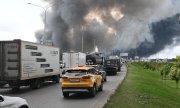
Attack on Moscow oil refinery: Putin under pressure?
Ukrainian drones struck an oil refinery in Moscow on Thursday. Ukraine's president Volodymyr Zelensky has confirmed the attack, writing on Telegram that it was "a just response to the constant Russian strikes against Ukrainian cities and towns". The oil refinery is one of the largest facilities in Russia and covers a significant proportion of the capital's fuel demands.
Unable to defend the capital
Now Moscow, too, is being made to feel the consequences of the war, writes blogger Serhii Marchenko on Facebook:
“Following the spectacular 'fireworks' on the fringes of the St. Petersburg Economic Forum, Putin has received another resounding slap in the face – this time in Moscow. The dozens of drones that breached Moscow's air defences are proof of Putin's inability to protect even his own capital. In my view, as of today far fewer Muscovites will support the 'special military operation'. After all, people always start to think twice when they've been given a good slap in the face.”
No munition for air defence systems
In a Telegram post republished by Echo, military expert Sergei Auslender sees Russia's air defence on its last legs:
“Despite the boastful reports from Mayor Sobyanin, under whose leadership the city has supposedly improved so dramatically, the drones are hitting their targets. ... The effectiveness of an air defence system isn't measured by the number of targets shot down, but by the damage it prevents. If a factory that was the target is hit – then the air defence system has failed. But it has now become clear to me: they simply lack the ammunition to operate the Pantsir, Buk and Tor systems. With attacks like these, production can't possibly keep pace with consumption. So in effect the Pantsir batteries on rooftops are more a psychological measure.”
Kremlin lies exposed to all
Political scientist Kirilo Sazonov writes in a Telegram post republished by gazeta.ua:
“Objectively speaking, attacks on any oil refinery are currently extremely damaging on a national scale. Of course, Putin claims that it will all be rebuilt quickly, but in the meantime every Russian can see: the bunker rat is lying. There are queues at petrol stations everywhere – even on the Moscow–St Petersburg motorway. Queues, rationing, bans on selling fuel in jerrycans. ... Every additional refinery that is taken out of operation is ultimately another critical 'wound' inflicted on the enemy. This has a particularly strong impact in Moscow. The fuel crisis in the capital is far more visible than anywhere in the provinces.”
Only the Russians left in the dark
Corriere della Sera explains that many Russians will be unaware of the attacks:
“Images of the plumes of smoke rising above the Moscow skyline were seen across the globe. Except by most of the capital's residents and the remaining 120 million Russians – at least those who don't have a VPN to access foreign websites. The 1 pm news, the country's most-watched television programme, reported on Vladimir Putin's summit with Southeast Asian heads of state, the Ukrainian attack [according to the Russian account] on a coach carrying two youth football teams in the Bryansk region in which one person was killed, the heavy snowfall in Yakutia and, finally, the signing of the ceasefire in Iran, 'to which Russia also made a significant contribution'. That was it.”
Awkard questions growing louder
Security expert Erkki Koort notes in Postimees:
“Firstly, Russia is facing major problems with its air defence, even in the capital, where police officers have resorted to using assault rifles to fend off drones. Secondly, Ukraine's success in its attacks against Russia can hardly be ignored, since this is not just limited to the Kursk region. This is making it increasingly difficult for certain sections of society to explain how Kyiv is able to inflict such suffering on one of the world's major powers. Thirdly, Russian rhetoric often frames the 'special military operation' in Ukraine as a war against Nato. In Russia, however, the question that is being posed more and more frequently is: if Nato is attacking us, why aren't we attacking Nato?”