
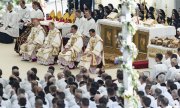
Pius Brothers rebel against Pope
Despite urgent warnings from Pope Leo XIV, the ultra-conservative Society of St Pius X in Switzerland has consecrated four bishops without the Pope's approval – an act by which those involved incur automatic excommunication and which triggers a schism within the Catholic Church. Commentators discuss how deep the rift goes.
This division is permanent
Arnaud Alibert, editor-in-chief of La Croix, sees a profound rift:
“Firstly, since yesterday it has been clear that the fundamentalists – as they are sometimes called to distinguish them from traditionalists loyal to Rome who also celebrate the traditional Mass [in Latin, prior to liturgical reforms] – are standing by their dissent. They have been excommunicated for their disobedience and are preparing to organise their autonomy on a permanent basis: with new bishops, including very young ones, for the coming decades. Secondly, with their rejection of dissent and critical thinking, they fully embrace their fallacious narrative – which today might also called 'conspiracy theory' – regarding the Second Vatican Council, which they claim was insidiously distorted by modernist ideologues.”
Victim of the sectarian mentality
The dispute within the Catholic Church is a symptom of the conflicts of our time, writes Polityka:
“Pope Leo has no choice. The sectarian mentality is alien to him, yet he has fallen victim to it. He has failed to resolve the 'modernist' crisis. We live in an age in which all manner of identitarian fundamentalisms are driving those who warn against them into a corner. Not only within the universal Church.”
An act of arrogance
Bruno Forte, Archbishop of Chieti-Vasto, sees personal interests at play in Avvenire:
“The followers of [founder of the Society of St Pius X, Marcel] Lefebvre have chosen excommunication and schism over obedience to the Vicar of Christ and the preservation of the Church's unity. ... All previous steps towards reconciliation, sought and approved by Benedict XVI, were in fact ignored. ... However, this is not the plausible reason for the schism: as has always been the case in the history of the Church, divisions reflect personal ambitions - not free of presumption and arrogance – and are for the most part political rather than religious in nature.”