
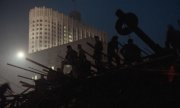
35 years ago: the August coup in the USSR
On 19 August 1991, a "State Committee for the State of Emergency" (GKChP) formed by Soviet hardliners seized power in Moscow. The coup against reform-minded President Mikhail Gorbachev failed after three days due to resistance from the people of the major cities and from the leadership of the Russian Soviet Federative Socialist Republic under Boris Yeltsin. The USSR collapsed within several months of the coup.
Even seemingly eternal dictatorships can collapse
Writing on Facebook, exiled politician Maxim Reznik does not rule out the possibility that the Putin regime could collapse just as quickly:
“I still remember the overriding feeling of those days: when people stop being afraid and take to the streets together, even the most fearsome power suddenly proves not to be as all-powerful as it seemed. ... Dictatorships that seem eternal sometimes collapse far more quickly than one can imagine. The State Committee on the State of Emergency, or GKChP, also believed it had everything under control – the army, television, the state apparatus. ... Yet within a few days it all fell apart. That is why I believe that the current situation won't last forever. ... I am certain that I will live to see the dawn of freedom.”
People weren’t intimidated back then
There was far more political freedom in the Soviet Union than there is in Putin's Russia today, human rights activist Lev Ponomaryov explains on Echo:
“Today's Russia is radically different from the Russia of 1991. Back then, the scope of freedom had been steadily expanding for several years. Political prisoners were released. Censorship was relaxed. Independent organisations sprang up. Competitive elections were held. Hundreds of thousands could take part in rallies and return home without fear of facing mass persecution. Much of the credit for this goes to the leader of the USSR himself: Mikhail Gorbachev. Fear gradually receded. Today, the opposite is happening.”
The end of the communist church
The collapse of the USSR was inevitable because it was defined by an outdated ideology, writes Neatkarīgā:
“The ideological foundation of this state structure – communism – had failed. The Union of Soviet Socialist Republics was, even by its very name, not a geographical or territorial entity. Although in the minds of many – not only in the USSR but also in the rest of the world – it was an alternative designation for Russia, in reality it was a theocratic, extraterritorial entity in which communism was the ruling ideology. The USSR was a state in which power lay not with administrative, secular structures, but with party structures (a communist church).”
Fruitless search for the designated governor
Estonia shows a deficit in coming to terms with the Soviet era, writes Delfi's chief editor Urmo Soonvald:
“For 35 years there have been low-key discussions in Estonia about who was to become Estonia's leader following the coup – first in Moscow, later in Tallinn. Latvia and Lithuania have found the answer to this question regarding their own countries, but we haven't, and the search for that answer has become something of a national pastime each year around 20 August [Estonia's Independence Day]. ... This gap in our knowledge about recent history is worrying and suspect. Compared with other Eastern and Central European nations that shared a similar fate, Estonia is a country in which relatively few men and women who collaborated with the KGB have been brought to light.”