
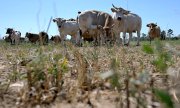
Drought and heat: the agricultural sector in crisis
Dry soil, withered plants, meagre harvests and not enough feed for livestock: the heat and droughts of this record-breaking summer are taking a heavy toll on agriculture in Europe. Many farmers are already reducing their livestock numbers as a result. The media ask whether government aid can be a lifeline and how the agricultural sector can adapt to climate change.
The market offers no salvation
The current economic model cannot guarantee secure supplies, warns L'Humanité:
“Measures to adapt to this new climate reality can no longer be put off. It requires radical changes to agricultural models and practices, massive investment in research, and collective protection for farmers, who are exposed to ever more severe shocks. Meeting these challenges is impossible under the yoke of 'free and undistorted competition' which guides EU policy. Leaving the market to regulate itself puts thousands of farms at risk and jeopardises access to food for millions of people.”
Build up the reserves!
In view of the climate crisis and wars, Hungary needs to prepare for a food crisis, argues Élet és Irodalom:
“Food security means that a minimum level of agricultural capacity is in place and that stocks have been built up which, in critical situations, can guarantee food supplies from exclusively domestic sources over a relatively long period – perhaps even months. In today's Hungary this is not the case either in law or in practice; in other words, there are neither legally mandated, deployable [agricultural] capacities nor state-maintained food reserves that could last for several months, as is the case with oil or natural gas.”
Farmers need help
There's no alternative to providing support to farmers, Der Standard stresses:
“What farmers need after total crop failures is financial aid. ... Everyone will pay the price: milk, meat and cereals will continue to get more expensive. ... Globally, food prices are their highest level in three years. ... The crisis is a bitter foretaste of the upheaval to come in food production. ... Heat-resistant crops, crop rotation and more effective irrigation are needed. Soil must be protected from erosion, and lost humus must be replenished to act as a water reservoir. Crops such as maize are not viable in arid regions. Farmers will not be able to manage this on their own.”
Prevention instead of cash injections
Kurier calls for more preventative measures and personal responsibility on the part of farmers:
“Farmers, too, must adapt their business models. ... Austria's agricultural sector must become more resistant to heat – and politicians less resistant to learning. If the past few years of crisis have taught us anything, it's that we would benefit from taking more personal responsibility. That there is no point in throwing money at real problems until they grow to the point where they can no longer be concealed. Austria can simply no longer afford the 'whatever it costs' approach. The magic word is 'prevention'. In the current case, this means adapting to extreme weather events – and implementing a climate policy that is worthy of the name.”
Switching to nightshifts
Naftemporiki outlines how the heat impacts working conditions:
“Farmers and livestock breeders in the UK, Spain, Italy and France are adjusting their working hours and investing in cooling systems. ... Farmers are already starting to harvest as early as 2 am, taking advantage of the cooler night temperatures to raise moisture levels in their crops and thus still meet their customers' requirements under extremely dry conditions. ... These changing working patterns highlight how the food industry is being forced to adapt at the farm level to increasingly unpredictable weather.”
We need trees and hedges in the fields
In an article in Le Monde, landscape engineer Philippe Hirou and ecologist Jacques Tassin make the case for agroforestry, a practice more common in the tropics in which trees are integrated into crops and pastureland:
“Trees are living organisms that play a fundamental role in regulating the environment and increasing resilience. We should make use of this resource, which is a natural way to channel rainwater deep into the soil, regulate temperature fluctuations, mitigate the damaging effects of excessive sunlight on the soil, reduce wind speeds and even sequester excess carbon. When managed properly, trees can be among farmers' best allies. Yet proponents of the prevailing agricultural model often portray hedgerows as relics of the past: as useless and restrictive.”
Major water consumers must pay more
Water must become more expensive in Germany, argues the Süddeutsche Zeitung:
“But this does not apply across the board or equally to all users. Drinking water is a human right, and access to it must not depend on one's financial means. ... However the time has come to make large commercial consumers foot a greater share of the bill. Farmers, drinks manufacturers, industrial companies and energy suppliers consume around three-quarters of the fresh water in this country. ... Water is no longer an inexhaustible resource in Germany; conflicts over its use and disputes over its distribution are on the rise. It would be extremely naïve to believe that companies won't have to deal with this. Which is why, in their own interests, it would be better for these companies to take precautions now rather than find themselves under pressure and in dire straits later on.”