
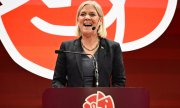
Social Democrats strongest party in Swedish elections
The centre-right coalition led by Prime Minister Ulf Kristersson – with the support of the right-wing populist Sweden Democrats (SD) – may have lost its majority in yesterday's general election. The Social Democrats emerged as the largest party and could now secure a narrow majority with a centre-left coalition, while the SD lost votes. However the final official election result is not expected until Wednesday.
Jointly assume responsibility
Dagens Nyheter says pressure should be exerted on conservative Prime Minister Ulf Kristersson to reach out to the Social Democratic leader:
“Magdalena Andersson has made clear throughout the election campaign that she is interested in working with the Moderates. So far, Kristersson has dismissed such ideas with nothing short of derision. But defeat will soon be a reality. The only option left to him will be life in opposition. ... Or a new path. Because if [Björn] Borg, the Wallenberg [family] and the billionaires who campaigned alongside the Moderates are serious about their concerns, there is only one sensible course of action: to exert pressure on the Moderates. And ensure that Ulf Kristersson assumes responsibility.”
A victory for the broad political centre
For Sydsvenskan the Sweden Democrats' loss of support sends a signal:
“Admittedly, this can be interpreted as indicating that two highly polarised camps are standing on either side of a deep divide. However, it must also be noted that a large majority of voters support parties from the broad political centre. The next person tasked with forming a government, whoever that may be, should humbly take this into account. After all, the message is that a large majority wants neither a marked shift to the left – with a billionaire tax and an 'everything for everyone' approach – nor an SD-dominated government that devotes all its energy to deporting people from ethnic minority backgrounds and making their lives difficult.”
Scoring points on social welfare
Ultimately it was a choice in favour of the Swedish model, La Stampa concludes:
“A model based on a strong welfare state, a well-functioning state education system, accessible healthcare and a public safety net that remains one of the pillars of the Swedes' national identity. Following an election campaign that began by focusing on crime, immigration and security and ended with discussions about the welfare state, a majority appears to have emerged at the ballot box that wants to return to Magdalena Andersson's centre-left coalition and weaken the nationalist right led by [Sweden Democrats leader] Jimmie Åkesson.”