
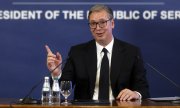
Serbia: Vučić resigns ahead of general election
Serbia's President Aleksandar Vučić announced his early resignation on Sunday, as he had already indicated back in June. He will now stand as the lead candidate for the Serbian Progressive Party (SNS) in the snap parliamentary election on 25 October. If he wins the election he could continue to pull the strings in Belgrade as prime minister. The media speculate on whether his strategy will pay off.
Goliath pretending to be David
Vučić’s new role is driven by populist tactics, Vreme notes:
“On the one hand, he can now present himself in Serbia as an ordinary man, one of us, modest and humble, driving an old Škoda, in an attempt to polish up his image. ... He can continue to control the state apparatus via party officials and, in effect, pull all the strings without formally taking responsibility for any of the unpleasant things that might occur amid the tensions in the run-up to 25 October. ... Instead of playing the card of the powerful man who listens to the problems of the poor, he is now trying to win sympathy by presenting himself as the David who is single-handedly taking on the demonstrator-Goliath that wants to destroy everything.”
Toppling the regime is the top priority
Večer takes a closer look at the Students' List, Vučić's main rival in the election:
“It does not feature any students, but rather people selected by student plenums – professors, doctors, activists, athletes and artists. The students are striving to be the polar opposite of Vučić and his Serbian Progressive Party. ... They have no comprehensive election manifesto. Instead, they're focusing on the democratic overthrow of the regime and postponing other ideological issues until after the election. Opinion polls, many of which are unreliable, currently predict a close result.”
Many Serbs are fed up
Ria Novosti looks at the possibility that Vučić could lose the parliamentary elections under circumstances similar to those faced by Viktor Orbán, who was also supposedly firmly in the saddle in neighbouring Hungary:
“Vučič's main opponent will be neither a leader of comparable stature nor the desire of a section of society (which, incidentally, is growing ever smaller) for EU accession, but rather weariness with this era. The Serbs' reservations about the president are reminiscent of the internal criticism levelled at the former Hungarian Prime Minister Viktor Orbán, who was a true tribune of the people with popular policies yet still lost the election despite having always won previously. In Serbia, too, the balance could tip either way.”
Both pro-Ukrainian and pro-Moscow
24tv.ua outlines the complex relations between Belgrade and Kyiv:
“Serbia supports Ukraine's territorial integrity, whereas Kyiv does not recognise Kosovo's independence. During a meeting with Volodymyr Zelensky in Belgrade on 8 August, Vučić reaffirmed this position and thanked Ukraine for its supportive stance. However, the limits of this rapprochement are also clearly evident, as Serbia is avoiding any moves that Moscow might interpret as open confrontation. For example, during a visit to Kyiv in July, Vučić pledged humanitarian aid but refused to endorse a joint declaration calling for increased pressure on Russia.”