
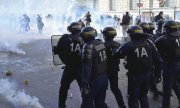
Protests and violence: what's going on in Europe’s cities?
All because of a broken promise
Der Freitag comments:
“Across Europe, the protests are directed against different governments and have different causes, goals and themes. In some cases it's about education, in others rents, or corruption. ... And yet there is a clear common element to the protests on the streets of Paris, Lisbon, Rome, Tirana and Madrid: they are for the most part driven by young people. ... What appears to be a generational conflict is on closer inspection a conflict between the promise of a bright future and the increasing awareness that this promise is unlikely to be fulfilled. Today's youths are united by this broken promise.”
Violence devoid of politics
In a commentary piece in La Repubblica, columnist Michele Serra tries to explain the riots in Milan:
“The classic notion of political violence, which we Italians know better than anyone else in Europe, doesn't seem to be a useful framework for understanding current events. There is no trace of ideology or opinion, nor any hint of organisational intent among the hordes of hooded youths looting shops in the city centre. It isn't even a mobilisation, but merely a message spread by word of mouth via smartphones: 'Let's go and smash things where the rich live.' This is social unrest in its purest form, but without any political orientation to speak of.”
Unholy alliance has declared war on the West
Times columnist Melanie Philipps takes a dim view of the situation:
“This is what's been termed the 'red-green alliance', an unholy collaboration between the far left, Islamists and supporters of the Palestinian cause. ... We're witnessing a much broader and deeper challenge than merely a crisis for France. It's a war on the West being waged by groups with disparate agendas taking advantage of a civilisation in deep trouble. Those involved are leftists, anarchists, Islamists, assorted grievance artists and useful idiots imagining they're marching for the 'oppressed' of the earth – and with malevolent outside actors stirring the pot.”
Fears of Islamist-leftism
Jyllands-Posten fears that all Europe could become a breeding ground for extremism:
“Today, the many millions of Muslim immigrants in France are unorganised, and voter turnout is low. But if they organise themselves and start voting as a bloc, they would represent a force capable of turning France upside down. The demographic landscape that has created a breeding ground for Islamo-leftism in France is also to be found in England and Sweden, among other countries. The fires now burning in France are blazes that could spread to the rest of Europe.”
Cutbacks in education ruining prospects
The Salzburger Nachrichten expresses understanding:
“In France in particular, the protests have in some cases descended into violence, which must be strongly condemned. However the underlying causes of the protests are entirely legitimate and a worthy cause: in many of these countries it is issues relating to education, schools and higher education – in some cases combined with a grossly overpriced housing market – that are infuriating young people. And almost everywhere they are faced with governments that seem helpless and would rather do nothing to address these grievances. ... Yet it is clear that with their austerity measures in the education sector, the authorities are sawing off the very branch on which many EU states sit: the intellectual potential and future prospects of their young population.”
Better to protest than to just play along
In a Telegram post republished by Echo, human rights activist Anastasia Burakova defends the right to protest:
“Protest culture varies greatly across Europe: in some countries trade unions and strikes are more common, in others roads are blocked, elsewhere public squares are occupied, whereas in other countries it is government buildings. ... Not every protest is accompanied by violence, and not every mass strike achieves its aim. But I'd rather pick my way through the anarchists' tents in one of the busiest squares in the centre of Madrid than listen to people saying that we shouldn't stick our necks out, that the government knows best, and that we're not interested in politics.”
Poverty, corruption and a weak economy
Young people in Albania are rebelling because they live in a country with no prospects, says Documento:
“The bureaucrats of the old communist system moved into the new political structures and continued to plunder the state coffers at the expense of the citizens. At the same time, due to the complete lack of a new productive structure in the 1990s, hundreds of thousands of Albanians emigrated, mainly to Greece. ... This led to the most productive sections of society leaving the country, while those who remained got by on remittances from abroad. At the same time, a new, parasitic elite emerged in which politicians, senior civil servants (judges, police officers) and 'private individuals' are closely intertwined.”
Distorting the facts is also harmful
Writing in NV, Oleksii Kopytko, coordinator of the NGO Information Resistance, urges Europeans to remain objective:
“Remember the Maidan of 2013–2014. Protests raged on Maidan Square as well as two to four blocks around it. Yet just one kilometre away, absolutely nothing was happening. The media gave the impression that the whole of Kyiv was ablaze. ... The media's perspective – and in particular that of social media – distorts events to the extreme. ... The rumours that Europe is sinking into chaos are somewhat exaggerated. There are reserves of stability, and there are options for action. Everything depends on whether it is able and willing to make use of these options. ... We in Ukraine have a vital interest in ensuring that control over the situation is not lost.”