
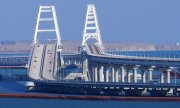
Ukraine critically damages road bridge to Crimea
After two nights of drone and missile strikes, Ukraine has rendered the road section of the Kerch Bridge, which opened in 2018 and connects the Russian mainland to the annexed Crimean Peninsula, unusable. The central arch of the bridge, which is more than 200 metres long, collapsed into the sea on Tuesday morning. Commentators discuss political and military consequences.
Showpiece now blocking traffic
The damage will be painful for the Kremlin as the bridge was Putin's favourite project, Salzburger Nachrichten notes:
“From a propaganda perspective, the destruction of the central section is a major blow. The bridge across the Kerch Strait between Crimea and Russia symbolises Russia's successful annexation of the Ukrainian peninsula in 2014. The 19-kilometre-long structure is regarded as Vladimir Putin's pet project. ... Now the central section and the bridge arch are underwater. They may hinder, if not completely block, shipping traffic between the Black Sea and the Sea of Azov until further notice. ... [Road] traffic must now be mostly diverted to the R280 motorway, which runs through occupied southeastern Ukraine and is constantly being hit by drones.”
Limits of Russian power exposed
The loss of the bridge is not just a military blow for Russia, the Frankfurter Allgemeine Zeitung points out:
“Politically, the Ukrainian operation has once again left Putin looking bad, both at home and on the international stage ahead of his meeting with Xi Jinping and Trump in China. The bridge was a key symbol of his seemingly unstoppable policy of expansion. The fact that the Ukrainians have now damaged it using their own weapons highlights the limits of Russian power and the advances made by Ukraine on this frontline section, too. This is by no means trivial, particularly from Trump's perspective, as we have seen on numerous occasions.”
Humiliating for both Putin and Trump
For Gazeta Wyborcza the attack is a Ukrainian counter-offensive against two powers at once:
“The Crimean Bridge – one of Putin's propaganda projects – was at the very top of the list of untouchable targets. It was important to the Russians that, despite the setbacks on the front line, it remained a symbol of their dominance. ... Fearing Moscow's reaction, the Americans accepted that the structure would remain off-limits. ... The Ukrainians were forbidden from using US weapons to attack this target. ... Two years ago, Trump seemed to believe that it was enough to shout at Zelensky and humiliate him in front of the cameras for him to give in and do as he was told. Zelensky has now spectacularly demonstrated his independence to the world.”
Negotiating positions reset
Writing on Censor.net, journalist Oleksiy Kurpas sees a significant shift in strategy driven by Ukraine's new Defence Minister Yevhenii Khmara:
“While the attacks on the Crimean Bridge attracted almost all the attention, the strikes against Bashkortostan went virtually unnoticed. ... Before those strikes our drones had targeted Novy Urengoy, Tyumen and Murmansk. ... Khmara is taking out the links in the enemy's economic chain one by one. And there is another important effect: the undermining of Putin's position. The day after tomorrow there will be a three-way meeting between Trump, Xi and Putin. Putin will look like a loser who has been humiliated right before the meeting. ... Such strikes don't just change the logistics. They also alter the negotiating positions.”
Retaliation could be devastating
Writing on Facebook, political scientist Nikolay Mitrokhin reflects on the consequences of the attack for Ukraine:
“In retaliation, Russia has once again targeted bridges across the Dnieper in Kyiv and beyond which are vital for supplying the front line. ... Without these bridges it will be extremely difficult to keep supplying the population in eastern and parts of northern Ukraine with food and goods, or to guarantee the transport of materials required by the factories located there. A collapse of the supply routes between the right and left banks would inevitably lead to a weakening of the front's defence capabilities and stability. Was the political impact of destroying the bridge worth all this?”