
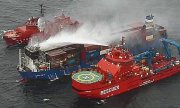
Ukraine hits targets in the Baltic and off Libya
According to reports from Kyiv, Ukrainian naval drones have sunk a Russian warship near Benghazi, off the coast of eastern Libya, and attacked a freighter carrying military supplies. Ukrainian drones also set fire to a Russian military cargo ship in the Baltic Sea that was en route to Kaliningrad on Friday, causing it to drift temporarily into Finnish territorial waters.
No Russian warship is safe now
Ukraine's growing military capabilities are really upping the pressure on Russia, The Daily Telegraph observes:
“What the attack demonstrates is reach. Merkury was destroyed some 1,200 miles from the Ukrainian front lines, just a day after drones struck a sanctioned Russian cargo vessel in the Gulf of Finland. ... Moscow's maritime supply lines stretch from the Baltic to the Mediterranean, and Ukraine can now strike both ends. ... Ukraine has demonstrated that no Russian warship is safe, in any sea. Moscow has shown, once again, that it refuses to learn.”
The right to defend itself
The taz discusses the legitimacy of Ukraine's attacks:
“Does Ukraine have the right to do this? Of course it does. Any military installation belonging to the aggressor is a legitimate target under the right to self-defence. ... Should Ukraine do this? Here opinions are divided. Attacks in the waters of states not involved in the war are reckless, and starting new war in Libya could be just as counterproductive for Kyiv as antagonising its ally Finland. But the killing of uninvolved civilians in their sleep should outweigh strikes against cargo ships carrying military supplies. If Russia wants to protect its ships, it should silence its weapons. If Ukraine wants to protect its people, it must neutralise Russia's war machine.”
Living dangerously by key sea transport route
Delfi warns that Estonia must also be prepared for further incidents of this kind in its own waters:
“The Gulf of Finland is vital to Russia. Bloomberg estimates that around 40 percent of its oil exports that are transported by sea pass through this route. It is the most important access route to the open sea and the supply route to Kaliningrad. Moscow's determination to defend these routes must be taken seriously. ... Estonia may well find itself having to deal with situations that we neither triggered nor caused, but which are a direct consequence of Russia's war of aggression. This requires well-planned and rehearsed operations, as well as a clear chain of command.”
Baltic countries must be vigilant
Postimees warns against allowing the war to spread, but also against continuing maritime trade with Russia:
“Recent events show that Ukraine has no problems attacking targets in the Baltic Sea that it regards as legitimate. At the same time, however, all countries bordering the Baltic must be more vigilant, because a naval war there would also be problematic for us. Firstly, unforeseen incidents could occur; secondly, the attacks could cause marine pollution. ... The latest developments in the Baltic could send a signal to those shipping companies that are profiting from supplying the Russian war machine.”
Tanks in Africa and pack mules in Ukraine
Writing on Facebook, political scientist Nikolay Mitrokhin pokes fun at Russia's military involvement in Africa:
“What an irony of fate. Russia is losing cargo ships packed with tanks, reconnaissance vehicles and other armoured equipment sent to chase the Tuareg across the Sahara, while in its own main war it is losing partly because its troops have to transport everything they need in old Ladas, on foot or on donkeys. A case in which geopolitical games are eating away at a country from within. In this respect, Russia has indeed caught up with Portugal. Not today's Portugal, however, but that of around 1974 [when the Carnation Revolution took place and the Portuguese colonial wars ended].”