
Nvidia: Huang's comeback all down to Trump?
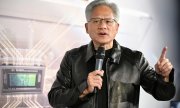
The share price of the AI industry's leading chip manufacturer rose by more than 30 percent following Jensen Huang's reinstatement as CEO of Nvidia on Monday. Donald Trump has boasted that he was behind the decision taken by the company's board of directors. According to press reports, the move increased the value of the US president's own shares by 15 million dollars. European commentators shake their heads in disbelief.
When market and state merge
The whole affair has unfolded at an alarming pace, Berlingske remarks:
“The entire course of events surrounding Jensen Huang's reinstatement confirms all the preconceptions about political corruption that are causing growing concern among Americans. The US Attorney General, Trump's personal lawyer Todd Blanche, had Jensen Huang cleared of any wrongdoing even before an investigation had taken place. ... Trump's intervention in the Jensen Huang case is the opposite of capitalism, and is more reminiscent of a fascist or communist state where the market and the state have become one.”
AI sector's foundation built on sand
According to Deutschlandfunk, the surge in Nvidia's share price only highlights the real problem:
“Many people cannot conceive of Nvidia without Huang. This is because he has moulded the company – and an entire industry around it – in his own image. It funds start-ups and cloud providers, which in turn use this money to buy Nvidia chips. This is a cycle that inflates growth and has become a systemic risk. That was evident last week when Nvidia's share price continued to plummet, dragging down other tech shares linked to AI and, ultimately, entire stock markets in its wake. A company whose value hinges on a single person is a foundation built on sand for an entire sector of the economy.”
Tech bosses as masters of the universe
Helsingin Sanomat considers the tech elite to be out of touch:
“The heads of AI and technology companies seem to support one another because they regard themselves and their companies as so special that they are not bound by the laws and morals of the 'normal' world. One gets the impression that they see themselves as the chosen few in the AI revolution, fulfilling a valuable historical mission that must not be hindered. Perhaps the AI and tech elite believe that only they understand the significance of this technological revolution and know what risks can be taken to drive it forward. The company's market value and their own self-worth appear to merge into one.”
Immunity proportional to market value
Ethics are cast aside, Protagon observes:
“We're not just talking about a culture of impunity here, but about the fact that actions have no consequences whatsoever. ... The former means that they are not punished. The latter means that nothing changes in their lives. The world of Trump and Huang is not necessarily more corrupt; corruption is a global and deep-rooted phenomenon. What is different in their case is the normalisation of this state of affairs: they don't even maintain the pretence. Your immunity is proportional to your market value. If these trends are allowed to continue unchecked, they will probably lead to two things: firstly, even more impunity for those in power; and secondly, growing revulsion amongst the population.”
A story with no moral
There is nothing here to inspire confidence, Kurier comments:
“The moral of the story? There isn't one, because it's completely absent. The CEO's misconduct was pardoned by the those at the very top. Because there's too much money, too much knowledge and too much power at stake. Even the US president is standing by his AI brain. And in doing so he is once again fulfilling his role as patron of the US economy – and, no doubt, of his own stock portfolio, too. The greatest threat posed by artificial intelligence is its unpredictability. In that respect, the Jensen Huang case fits the picture perfectly. No one could have come up with such a crazy script. This is not what measures to build trust look like.”
Tech bosses too big to fire
Corriere della Sera identifies two key developments in the US:
“The first began with the 2008 financial crisis. True to its liberal economic stance, the George W. Bush administration [2001–2009] allowed Lehman Brothers to go bankrupt. This triggered a domino effect that, shortly afterwards, forced it to bail out banks and insurance companies that were on the brink of collapse. This is how we discovered the companies that are 'too big to fail'. ... Nowadays, it is out of the question to let high-tech and AI companies fail, because they are strategically important. ... Which means that their CEOs, from Huang to Elon Musk, have become 'too big to fire'.”
Even visionaries are mere mortals
Big tech companies must not be dependent on a sole individual, warns Le Temps:
“This techno-political thriller vividly highlights how important companies like Nvidia, SpaceX and others are for the US – but also how dangerous their problematic corporate governance can be. ... Given their strategic nature, these companies are now of systemic significance. Under no circumstances should they be dependent on a single individual – however brilliant that person may be. ... For while the Elon Musks, Sam Altmans and Jensen Huangs of this world are undeniably visionaries, like the rest of us they remain mere mortals. Given the naivety of Nvidia's CEO, one is even tempted to add 'weak men'.”
A mirror of the Chinese Communist Party
Huang's return to the helm of Nvidia highlights serious flaws in the company's management, the Financial Times argues:
“Huang led a multitrillion-dollar company without installing either a board of directors or a management structure worthy of the name. Nvidia had no board chair, no evidence of board independence, no succession plan. Its org chart is a mirror of the Chinese Communist Party's: a mess of arrows all leading to one man. Huang was reinstated not because he is the right person for the job, but because his failures, plus presidential support, left his company with no other options.”