
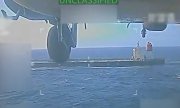
US seizes another oil tanker off Venezuelan coast
The US military has seized another oil tanker off the coast of Venezuela. This vessel is believed to be the Panama-flagged Centuries. The Venezuelan regime of Nicolás Maduro described the seizure as a "serious act of international piracy". Washington said that the US would continue to crack down on the illegal trade in sanctioned oil from Venezuela and Iran.
Russia and China are a different story
Radio Kommersant writes:
“Should the situation escalate, it could trigger a price increase. However, this would also lead to increased purchases of Russian oil by China and India, which could be beneficial. Of course, in the long term the US government could begin to use its navy for other tasks, such as hunting down the Russian 'shadow fleet'. … However, Venezuela cannot be compared to Russia or China. … A naval blockade against the latter would be considered a reason to go to war under maritime law, and the Americans would not be willing to risk that.”
How the sphere-of-influence logic works
Die Welt explains why Russia and China remain silent:
“Their motive is easy to discern, although it's astonishing to note that Trump himself seems oblivious to their underlying reasons: a major power that views its neighbourhood as its own territory into which no outsider may even set foot without permission must also recognise the spheres of influence of others. In other words, if Washington declares Latin America its backyard, it will lack the arguments to protect Taiwan from China or to play an independent military role in the South Pacific. According to this Trumpian understanding, Moscow, for its part, will be free to swallow up Ukraine. Is this really how it should be?”
No plan for the day after
Polityka bemoans the lack of a long-term strategy on the US side:
“The problem is that even if a change of regime were to succeed (which the Americans have almost never managed to achieve in recent decades), no one would know what should come next in Venezuela. There seems to be no plan for the 'day after' because sudden democratisation is difficult and unlikely. Even the forced installation of Nobel Peace Prize winner Maria Corina Machado in the presidential palace would be problematic – it's unclear how the uniformed security forces would react. The formation of a right-wing government in typical Cold War style would perhaps be the easiest option, but this would probably require considerable financial investment and a US military presence. And that is exactly what Trump and Rubio want to avoid at all costs.”
Caribbean Netherlands in danger?
The Caribbean islands of Curacao, Aruba and Bonaire, which belong to the Netherlands and lie off the coast of Venezuela, could also be affected by the conflict. Trouw says the Dutch government should now take decisive action:
“With its military actions against Venezuela, the US is obviously jeopardising the international legal order. But this threat of war in the US's 'backyard' also affects the Caribbean parts of the kingdom. Consequently, the Netherlands should sound the alarm even more clearly vis-à-vis the US; otherwise it could easily be dragged into this military conflict.”
A shameful act
For the Süddeutsche Zeitung's Latin America correspondent Jan Heidtmann, it is now clear what Trump is really after:
“The US is determined to topple Maduro and his regime. ... His goal is to secure US access to the world's largest oil reserves. From his point of view, that's understandable — but how this aligns with Machado's promises to build a just society in her country is questionable. One thing, however, is certain: Machado will have to pay a high price for Trump's support. The saddest role in this drama is played by the Venezuelans themselves. ... Even after Maduro's fall, they will hardly have a say in their country's future. What's unfolding there is simply a shameful act.”
"Peacemaker" Trump playing with fire
US President Trump is treading on thin ice here, writes Lidové noviny:
“The Venezuelans may not like their rulers much, but in many cases they hate America even more. ... More than 80 percent say they would defend their country. ... Crossing the Rubicon in Venezuela – that is, launching a direct attack – might be grudgingly tolerated by Russia and China, which behave similarly in their own regions, but not by Latin America. ... A conflict in America's backyard could ultimately cost billions in taxpayers' money. And how would 'peacemaker' Donald Trump then be any different from his predecessor George W. Bush – or even from Vladimir Putin?”
Predictable chaos
De Volkskrant doubts that a change of government imposed from outside can lead to stability:
“Trump wants to do business. The United States has always maintained close relations with Venezuela, from which plenty of oil flowed to American refineries until socialist leader Hugo Chávez put an end to this in 1999. Many Venezuelans would welcome a change of government, but given that Trump is acting purely out of economic self‑interest, they should harbour no illusions. A regime change imposed from outside for dubious reasons generally leads above all to chaos.”