
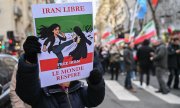
Is regime change possible in Iran?
"Finally, to the great proud people of Iran, I say tonight that the hour of your freedom is at hand." US President Donald Trump made this promise to the people of Iran in his speech at the beginning of the Iran War. Following the killing of Supreme Leader Ali Khamenei, the regime has appointed his son Mojtaba Khamenei as his successor. Commentators see little to indicate that the mullahs' power base has been weakened.
Mullahs have the country firmly in their grip
Delfi explains why regime change in Iran is a far more difficult undertaking than Washington realises:
“Has the White House really fallen prey to the illusion that missiles could destroy a brutal theocracy that has a firm grip on the country, and that once the shots have been fired the population will overthrow the mullahs? Unfortunately, a glance at Iran reveals a sad picture: the opposition is weakened, oppressed and fragmented; support for the successor to the last shah is insignificant; the ideological grip of the de facto power structure of the state - the Islamic Revolutionary Guard Corps - is unshakeable. Continuity in the chain of command, decentralised networks and established links to the armed forces in the regions ensure a resilience that can easily withstand the impact of individual commanders being killed.”
The hardliners have been strengthened
Der Spiegel points out that several prerequisites for change in Iran are missing:
“Either the war ends with genuine regime change or it achieves nothing at all: nuclear facilities can be rebuilt, commanders replaced - and the regime is adorning itself with martyrs while emboldened hardliners dismiss any future attempts at negotiation as naive. However air strikes alone are unlikely to bring about the fall of the regime. This would require boots on the ground and an opposition capable of filling a power vacuum. There is no sign of any of this at present. And if air strikes are deemed insufficient the conflict will end up at the next stage of escalation: ground troops, an entanglement from which it will be even more difficult to escape.”
Tehran's intimidation tactics continue
The mullah regime continues to persecute the people of Iran, human rights activist and writer Pegah Moshir Pour complains in La Repubblica:
“Tehran weeps not only for what falls from the sky, but for everything that has been taken from it over the years: its breath, its peace, its dignity, the very possibility of imagining a tomorrow. ... And while the city trembles, the regime does what it has always done best: not protect, but threaten. Citizens receive messages on their mobile phones, cold, harsh, designed to creep into their veins like another form of terror. These are messages about surveillance, control and punishment. ... As if a people already crushed by the weight of war, oppression and misery needed to be silenced with the toxic language of intimidation.”
Not a just war
For the Iranian people, nothing has changed for the better, Der Standard laments:
“The doctrine of a just war (bellum iustum) includes the killing of tyrants. The assassination of Adolf Hitler is often cited as a prime example, as it would have spared the world a great deal of suffering. The US and Israel see their actions in the same light: they have killed Supreme Leader Ali Khamenei. ... However, it's not as simple as that to claim that one is waging a just war. Here, too, there are prerequisites. To stick with the example of the assassination of a tyrant, this is only justified if it can actually put an end to the suffering. This is certainly not the case with Iran. The mullah regime continues to function, and nothing has improved for the people of Iran.”