
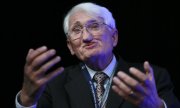
Philosopher Jürgen Habermas dies: what has the world lost?
The world-renowned German philosopher Jürgen Habermas has died at the age of 96. Beyond advocating respectful communication in theory, Habermas actively engaged in public debates. In Germany's famous Historians' Dispute, he insisted on the unique nature of the Holocaust. His 'constitutional patriotism' is the modern concept of defining belonging through commitment to democratic principles rather than ethnicity or cultural identity.
Sound arguments as a cornerstone of democracy
Habermas made the case for democratic dialogue, Naftemporiki explains:
“At a time when public discourse increasingly resembles a battlefield, Jürgen Habermas held fast to an almost old-fashioned, yet deeply radical idea: that democracy can only function if citizens engage with one another through reasoned argument rather than shouting. With his passing, one of the most important chapters in postwar European thought comes to a close. ... For him, the public sphere was the heart of democracy - a space where arguments count more than power, and where the legitimacy of political decisions stems from dialogue. In a Europe that was trying to heal from the wounds of Nazism and war, this idea carried particular weight.”
Public intellectual par excellence
Habermas's global fame is based on his willingness to get involved in controversial issues and debates, the Neue Zürcher Zeitung writes:
“Habermas's criticism of neoliberal tendencies in economic policy, his analyses of stagnant European politics right up to the present, his theories of law, morality, and democracy have been an integral part of interdisciplinary controversies within the scientific community - and they will remain compulsory as the contribution of a philosopher who understood his role to be not just that of an academic, but that of a public figure. ... Habermas once wrote of Heine that he was an 'author who intervened in the struggles of his time'. The same could be said of Habermas himself.”
Insights instead of noisy criticism
Habermas's work is like a lighthouse, writes poet José Paulo Santos in Visão:
“Habermas did not give us simple answers. He posed profound questions. He taught us that the legitimacy of norms is born from free discourse, that truth cannot be imposed but emerges in the fragile and courageous space of dialogue. In an age when instrumentalisation stifles listening, his work remains a beacon: it reminds us that reason is not just calculation, but also mutual recognition. For those who write, think, and fight for a more just society, the challenge remains to honour his legacy: to have the courage to defend the public sphere against the noise that seeks to smother it.”
Guided by the power of reason
We should all take a leaf out of Habermas's book, writes philosophy professor José Luis Martí in eldiario.es:
“He was the last great philosopher of the 20th century, the intellectual beacon of Germany and Europe, the most stable bridge between philosophical traditions, and the father of the finest contemporary ideas on democracy. ... According to Google Scholar, his works have generated over half a million citations. ... So how do we defend ourselves against the far right, against anti-democratic populism, against the power of global corporations, or Trump's barbarities? ... Habermas gives us the answer: we must do it together, on the streets, on social media and in bars, and - unlike Trump - we must do it guided by the power of reason.”
Russia will put his philosophy into practice some day
Political scientist Dmitrii Loboiko explains on Facebook that Russia is still in the process of learning from its experiences:
“Habermas always insisted that a stable collective identity was only possible through a critical reappraisal of a difficult past, not through its relativisation. His personal experience was realising, at the age of 15, that he was living in a 'criminal system'. Germany has learnt this lesson, albeit painfully and inconsistently. Russia faced the same historic turning point and took a far more difficult path. ... In Russia, Habermas was read, appreciated, understood - and perhaps he will yet be put into practice. At some point in the future. History unfolds slowly - as he liked to remind us.”