
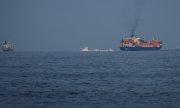
Strait of Hormuz: Trump extends US ultimatum
US President Donald Trump on Monday extended his ultimatum to Iran to open the Strait of Hormuz by five days, claiming that 'productive talks' with the Iranian regime were underway, although Iran has denied any form of contact with Washington. Meanwhile, attacks by both sides on targets in Iran and Israel continued into Tuesday morning.
Saving face is the top priority
Central Asia expert Arkady Dubnov describes on Facebook Trump's extension of the ultimatum as a first step toward ending the war:
“After all, it was he who first put his cards on the table. ... Trump made the right move in this instance: June crude oil futures dropped from 110 to 91 dollars a barrel, and it's up to him now to keep it that way. ... But Khameinei's heirs have also won. They will proclaim the withdrawal of the ultimatum as the surrender of the great Satan. The main thing is for both sides to save face. But Trump has taken things a step further, saying that he has seen the 'face' of Iran in a new light and insisting in an interview with CNBC that events in Iran constitute a form of 'regime change'.”
De-escalation with no guarantee of success
Trump clearly wants to start defusing the conflict, but Iran will not play into his hands, The Times writes:
“Winding down is unlikely to be as easy as he might think and will present him with some very difficult decisions. Even if carried off successfully, it will present many questions about what will have been achieved by starting the war. ... Even if Iran can conduct decisive talks in five days, its rational posture will be to drive a very hard bargain. ... For the regime it will be tactically important not to open the strait until a deal is fully made, politically vital to appear victorious to domestic opinion and strategically crucial to secure credible assurances against further attack.”
Uncertainty is Tehran's most effective weapon
Iran doesn't necessarily need to launch a major offensive to achieve its aims, writes Diário de Notícias:
“Iran knows it cannot win a conventional war against the United States and the regional coalition surrounding it. That's why it's pursuing an asymmetric strategy: to increase the political, economic and social costs of any confrontation. The threat that it will strike critical infrastructure in the Gulf is a classic example of this logic of deterrence by the weak against the strong. Tehran doesn't need to destroy all power stations or desalination plants; all it needs to do is convince its opponents that it is capable of doing so. Uncertainty is the best weapon and it may suffice.”
Tehran still has powerful leverage
In a Facebook post, Middle East expert Ihor Semywolos outlines a potentially shrewd strategy on Iran's part:
“Iran could opt for controlled restriction of the Strait of Hormuz, rather than choosing to completely block it or open it up. There are already indications that this is happening: Iranian tankers are continuing their journey to China via alternative routes, and individual ships are being granted permission to pass through. This gives Tehran lasting leverage – without formal capitulation and without full-scale escalation – a controlled pressure valve that can be used to negotiate at any time. Which is why any ultimatum demanding a 'full opening' of the strait is automatically doomed to fail against Iran's logic of partial concessions.”
Voters won't forget soaring petrol prices
Cătălin Buciumeanu, founder of the Inventikus Centre for Technological Innovation, writes on the Adevărul website:
“If Trump escalates the conflict, he runs the risk, from a political perspective, of having led America into a long, costly and toxic war. If he ends it abruptly, it could look like he has paid the economic price without having achieved any strategic results. And if he tries to shift the debate to focus on identity, culture and party loyalty, he will rediscover a fundamental truth: voters may forgive many things, but they rarely forgive a hike in the price of petrol.”
Washington is following a different logic
La Stampa highlights the differences between Israeli and US interests:
“Overnight, Washington announced through Treasury Secretary Scott Bessent that the sale of Iranian oil currently blocked at sea would be (temporarily) permitted. ... The contrast with Israel, which had attacked the massive South Pars gas field just the day before, could not be greater. … Jerusalem is attempting to destroy as much of the Islamic Republic as possible – its military capabilities, its leadership, and its energy and production infrastructure. Washington, by contrast, however elusive its ultimate goals may be, is pursuing a logic of military victory without political and/or economic risks.”
Forced to take a stance before the showdown
Europe won't be able to stay out of the war for much longer, writes the taz:
“April could be the month of the Iran showdown, potentially coinciding with the expected springtime resumption of the fighting in Ukraine, where Russia is losing ground but preparing new offensives – emboldened by the oil revenues that the war in Iran is pouring into its coffers. 'This is not our war', the words still coming from Europe last week, is no longer an adequate response. There is no European 'we' at the moment. Trump's war on Iran and, before that, his ambitions regarding Greenland have divided Nato, while the EU is being paralysed by Hungary's Viktor Orbán, a friend to both Trump and Putin. Every government must decide for itself where it stands and what it intends to do in this looming Third World War. Including the government in Berlin.”
Push for a ceasefire
Rafael Vilasanjuan makes the case for a deal in El Periódico de Catalunya:
“Trapped in Netayahu's war, no one trusts Trump. Back home, criticism is coming from within the party ranks and dividing Republicans, particularly the hardliners. Internationally, this war has isolated him, with the allies refusing to give their backing. Again, because they don't trust him. War is a very serious matter for every country, and President Trump is more like a capricious child with a weapon than a leader who inspires others to follow him. His ultimatum is pushing the war towards the brink, but there is still an alternative. ... A ceasefire in exchange for opening the Strait of Hormuz would have a better chance of success than Donald's certain descent into hell.”