
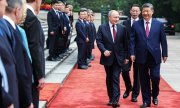
Putin in Bejing: partner or supplicant?
Hot on the heels of Donald Trump, Vladimir Putin has paid a two-day visit to Beijing. The Russian president and his host Xi Jinping publicly emphasised the strong ties between their countries. However, the two leaders failed to reach a deal on the construction of a new pipeline to export Russian natural gas. Europe's press analyses the international power relations.
Hardly a friendship with no limits
Romanian military expert Alexandru Grumaz comments in Adevărul:
“What Beijing and Moscow frequently refer to as 'multipolarity' essentially means that there is one main pole – China – and other actors that orbit around it. With its raw materials and nuclear arsenal, Russia remains a useful partner for Beijing – but not an indispensable one. The mere fact that China sells components to both Russia and Ukraine says everything we need to know about the nature of this 'friendship with no limits' – it has very clear limits, namely China's national interests.”
Moscow failed to secure its main objective
The trip didn't fulfil expectations on the Russian side, La Stampa comments:
“The first tangible result of the visit was the slump in Gazprom's share price on the Moscow stock exchange. ... The share price dropped by 3.5 percent in a single day. ... The reason for this is that the hopes which, on the eve of the China trip, Putin's spokesman Dmitry Peskov described as 'very important', have not been realised. The Kremlin has once again failed to persuade Xi Jinping to sign a contract for the supply of 50 billion cubic metres of natural gas per year via the Power of Siberia 2 pipeline.”
Russia being squeezed like a lemon
The taz describes Putin's dependence on China:
“Putin needs to try and offload his gas onto his eastern neighbour as quickly as possible, and at a huge discount. Xi is squeezing Russia like a lemon in the process. ... Russia is almost entirely reliant on 'Made in China' for supplies of technology and fibre-optic cables for its drones. Russia now sources 36 percent of all its imports from China. ... Chinese cars, lorries and buses already dominate new car sales in Russia and have virtually wiped out Russian factories. ... Chinese firms are clearing Siberian primeval forests with no regard for the environment. With his imperialist policies, Putin is turning his vast empire into a Chinese province.”
Spotlight on crisis in the US
Unlike Trump, Putin is a reliable partner for Xi, El País emphasises:
“The alliance between Russia and China sends a clear message to the world: the US does not occupy a dominant position. And this is the exact opposite of what Trump constantly claims. It also highlights the effectiveness, international predictability and coordination between Russia and China. Which is precisely what Xi is demanding of the US president when he talks of constructive strategic stability – in other words, the opposite of the chaos now reigning in the world's most powerful democracy, which is currently in the grips of a militaristic, authoritarian and illiberal trend.”
Poles that repel and attract
China's appeal is growing as the West's cohesive stance weakens, reflects Lidové noviny:
“Donald Trump is preventing the West from working together. ... The 'rest of the West', in particular the EU, is likely to turn towards China's soft power, even though Europe must be aware that this power is providing Russia with crucial support for the war in Ukraine. But this same power is also supplying Europe with affordable electric cars, solar panels and wind turbines – all the things that European politicians constantly preach about but have never managed to produce cost-effectively on a mass scale.”
Bound by Siberian natural gas
The Russian-Chinese partnership is based on energy supplies, explains columnist Pierre Haski in France Inter:
“For China, Russia is a treasure trove of fossil fuels on its doorstep, which is particularly valuable in these time of energy uncertainty. You only have to look at the delegation that accompanied Putin to China: all the energy oligarchs travelled with him. A second 7,000 km gas pipeline between Russia and China is being planned, Power of Siberia 2, which will deliver an additional 50 billion cubic metres of gas per year. ... This reinforcing of their energy partnership means it is highly improbable that the two countries will fall out in the foreseeable future.”
Not bromance but functional alliance
The bond between Xi and Putin is about shared interests rather than shared ideology, explains Handelsblatt:
“Both leaders want to push back against a world that has been dominated by the US for decades. And both stand to gain when Washington spreads chaos. Trump's impulsive foreign policy, his mixed messages in the Middle East and his erratic alliances are providing Beijing and Moscow with just the script they need. ... There is no bromance beneath the ostentatious harmony between these two autocrats. It's a functional alliance between two major powers which have learned that chaos can sometimes be the strongest bond in geopolitical partnerships.”
China wants a foothold in the far north
Political scientist Vadym Denysenko explains in a Facebook post picked up by Espreso that Beijing expects more from Moscow than just energy and loyalty:
“China will certainly demand concessions – particularly with regards to Russia making territory available for infrastructure along the Northern Sea Route. The fact is that China has already launched its polar trade convoys and is building ships specifically for this route (not nuclear-powered icebreakers, but cargo ships). However, these convoys sail without stopovers and don't call at any ports – primarily due to a lack of suitable bases and logistical infrastructure.”
Laying the foundations for a new world order
Xi and Putin are working to create a new form of globalisation independent of the US, writes Kirill Babayev, director of the Institute of China and Modern Asia, in Kommersant:
“This world must be built, piece by piece, undeterred by threats on the social media platform Truth Social – through a new international payment infrastructure, new mechanisms for trade regulation and a new form of globalisation. ... This is precisely the kind of world the countries of the global majority need today, and we can be sure that in the coming days Putin and Xi will be discussing exactly how to shape this new world – be it through the Eurasian Partnership strategy, the Brics or the SCO (Shanghai Cooperation Organisation).”
Host shining by comparison
China doesn't have to do much to look respectable compared with Trump or Putin, Interia observes:
“In 2026, the world is indeed revolving around the Middle Kingdom. First, President Donald Trump travelled to Beijing. Now President Vladimir Putin has paid a visit. Strangely enough, both look like supplicants in Beijing. ... For now, it seems that Chinese neo-imperialism, based on a patience that feels old-fashioned in the age of social media, is making the best impression. Never before have so many articles been written about how China comes across as serious and credible, particularly against the backdrop of Trump's erratic policies.”
Xi smug while rivals struggle
For La Stampa, the Chinese leader's medium-term goal is clear:
“He has set himself the not-too-distant target of overtaking the US by 2050. There's still a lot of work to be done before then. But Xi is realistic and content for the time being to position China as the stable and responsible major power between the other two, which are inextricably entangled in wars that are causing energy crises and trade tensions in the rest of the world. China's economic slowdown, a result of geopolitical resistance and competition in the Indo-Pacific, industrial overcapacity and demographic decline, is more than offset by the missteps and mistakes of Russia and the US. These mistakes have specific names: Ukraine and Iran.”