
Drone strike in Romania: how should Nato respond?
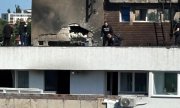
Two people were injured on Thursday night when a drone struck a block of flats in Galați, Romania. According to official reports the drone was Russian and carrying an explosive payload. At the same time, the Ukrainian Danube port of Reni, 20 kilometres away, was attacked. Romania ordered the closure of the Russian Consulate General in Constanța. Commentators see this response as insufficient.
Military reaction called for
For political analyst Abbas Gallyamov, the incident is no coincidence. He writes on Facebook:
“If Nato's response remains purely diplomatic, Putin will take it as an official invitation to invade. That's exactly how the 'hawks' in his inner circle will interpret it, at any rate. If I were in the alliance's leadership, I would order some units to be deployed further to the east. The response must be a military one. You have to hear the tank tracks grinding. I wouldn't rule out the possibility that the incursion was not accidental. Putin cannot yet bring himself to launch a full-scale invasion of the Baltic states, preferring instead to test the waters quietly.”
No longer the periphery but the first line of defence
In Adevărul, military analyst Alexandru Grumaz advises a fundamental shift in perspective:
“Speaking of an 'Eastern Front' rather than an 'Eastern Flank', as had been the case up to now, is not merely a change of terminology, but an expression of a new strategic reality. … The message is clear: Europe can no longer rely exclusively on protection from others. If it wishes to deter a revisionist and increasingly aggressive Russia, it must take its defence into its own hands, invest in credible military capabilities and preserve the political unity of the Western alliance. In a new European security architecture, the Eastern Front is no longer the continent's periphery but its first of defence.”
Government moving at a snail's pace
Despite its shared border with Ukraine, Romania is still ill prepared to counter attacks, complains republica.ro:
“For four years now, the Romanian government has been reassuring us, saying it is monitoring the situation and taking action. ... In reality, however, we're still stuck at square one. We have a new law that allows us to shoot down drones, but we're now discovering that there are far too many restrictions. ... We're moving at our typical snail's pace. After four years of war and three years since the first airspace violation by a Russian drone, we still don't have any air defence systems. What if this had been an even larger explosive payload?”
As if the war wasn't anywhere near
Nato is not prepared for military engagement, writes former MP Mustafa Nayyem on Facebook:
“A Nato country with aircraft in the air, with permission to fire and with a full understanding of exactly what is heading its way, nevertheless took no action against a single cheap Shahed drone – and not because anyone there got cold feet or overslept, but because its rules, its technology and its calm daily routine are not designed for war to come so close. And Russia – to judge by these strange incidents and the fact that wreckage from its drones has already been found on Romanian soil on several occasions – is methodically and almost calmly probing where exactly the eastern flank is at its weakest.”
Deploy defence systems earlier
Novinky.cz proposes that Nato countries expand their drone defences' area of operation:
“Romania, Poland, as well as Slovakia and Hungary and the Baltic states, are supposed to wait patiently until drones or missiles fly over their borders, which shortens the time available for a defence response. ... Legally speaking, this is okay, but it makes little sense. ... It might be more sensible to demonstrate that in such cases air defence systems would also intervene over countries neighbouring Nato territory. The Kremlin would growl like a rabid cat and bare its claws, but that would be it. Even the fiercest Russian hardliners would not condone an escalation.”
Nothing new
La Stampa sees this as a sign of Russian weakness:
“Every time Russian President Vladimir Putin finds himself in a tight spot in the war in Ukraine, he desperately tries to raise the stakes. This happened at the end of 2022, when Ukrainian forces liberated Kharkiv and Kherson and Putin brandished the nuclear threat to intimidate the US and Europe, prompting the then Biden administration to scale back its support for Kyiv. He is now doing the same by threatening the Baltic states and Romania with drone strikes. This is happening because, despite Donald Trump's betrayal of Ukraine and Europe, with Europe's support Kyiv is not only continuing to resist, but also making things very difficult for Moscow.”