
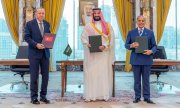
What does the new Sunni military pact portend?
Amid ongoing tensions in the Persian Gulf, Saudi Arabia, Turkey and Pakistan signed a defence pact in Mecca on Friday. An armed attack on any of the member states would be regarded as an attack on all, according to statements. Following the signing of the document, Saudi Crown Prince Mohammed bin Salman, Turkish President Recep Tayyip Erdoğan and Pakistani Prime Minister Shehbaz Sharif attended Friday prayers together.
Fresh solutions for a more stable Middle East
The Times hopes the alliance could provide new solutions to the region's security problems:
“It represents the first major step in the Middle East and South Asia towards an indigenous security architecture and a move away from a vassal-like dependence on the American security umbrella. It may also act as a hedge against any sudden shifts by the White House. In the Turkish and Saudi case, it is intended as a counterweight to Israel's power projection in the Middle East. And it is a recognition that Iran has emerged more strongly than expected from its extended war against its neighbours. ... It is best seen as a defensive state-to-state arrangement that could, over time, come up with solutions to challenges.”
No better than the predecessor
Sözcü points out that a similar alliance was formed a few years ago, but failed:
“On 15 December 2015, 34 countries joined forces – also under Saudi leadership – to form the 'Islamic Military Alliance'. That alliance was also compared to an 'Islamic army', and the then Prime Minister Ahmet Davutoğlu explained Turkey's participation as 'support for the fight against terror'. The Islamic Army never fired a single shot. It fell apart. That is probably why doubts are growing.”
Bad news for Washington
The alliance poses a problem for the US, La Stampa points out:
“The agreement expands on the bilateral pact already signed between Riyadh and Islamabad last September. ... While the text does not explicitly mention Tehran by name, the message is clear: the pact brings together Saudi Arabia's economic power, Ankara's second-largest Nato army and Pakistan's nuclear deterrence – the only one in the Islamic world. For Washington this creates a new, unpleasant and unknown variable: a Sunni bloc capable of acting independently, while the US is slowly withdrawing from the region and vacating the bases it had established during four wars since 1991.”
All eyes on the nuclear bomb
The taz explains why this alliance has come about:
“Pakistan has a large army, the Saudis have money, and Turkey has the military technology. All three stand to benefit from the plan, as it will make them less dependent on US arms purchases. But there is another, more far-reaching consideration. Although Pakistan is poor, it is nonetheless a nuclear power. Both the Saudis and Turkey assume that ultimately Trump and Netanyahu will fail to prevent Iran from building a nuclear bomb. They want to be prepared for this eventuality, and Pakistan's nuclear technology offers the best route to securing their own nuclear bomb, independently of the US.”
Still a long way from an Islamic Nato
Political scientist Farhad Ibragimov examines the motives for this the alliance in Kommersant:
“The wording of the agreement is reminiscent of Article 5 of the North Atlantic Treaty, even if there is still a long way to go before a new 'Islamic Nato' emerges: the decision-making mechanisms and the scope of the obligations remain unclear. ... Who is the new alliance directed against? The official answer: no one in particular. ... The unofficial answer is far more complex. Both the Iranian and the Israeli factor are identifiable in the agreement, as well as a growing mistrust in the US's ability to remain the sole guarantor of security.”
A role model for Kyiv
Journalist and TV presenter Kateryna Soliar explains on 24tv.ua why Ukraine should follow the example of Turkey and Saudi Arabia:
“Turkey did not say: 'It's either Nato or Saudi Arabia and Pakistan'. And Saudi Arabia did not say: 'It's either the US or a new defence alliance'. They opted for both. And I believe that Ukraine should think along the same lines. Perhaps we've been looking for a single guarantor [of security] for too long. For years we have been asking the same question: Who will guarantee Ukraine's security after the war? Nato? The US? Europe? But what if there isn't a single right answer among these three? Or rather: what if the right answer is 'all of them together'?”
Europe's waning influence
The Frankfurter Rundschau comments on the implications for European Nato members:
“Under no circumstances should Turkey, and because of the mutual defence obligation, potentially the entire North Atlantic Treaty Organisation as allies, be drawn into a military conflict with Iran. Germany's influence in the region, as well as that of its European partners, is waning as a result of the alliance. After the wars between Israel and the Palestinians and the military action taken by the US and Israel against Iran they have practically ceased to be a point of contact for states in the Middle East.”