
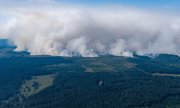
Wildfire in Belgium: takeaways for Europe?
Belgium's largest wildfire in more than a century has already destroyed an area of around 30 square kilometres in the High Fens nature reserve near Germany's border, and is still not fully under control. Around 500 people are working to contain the flames, and many residents have been forced to evacuate the area. Commentators discuss what the rest of Europe can learn from the disaster.
Consistency and joint prevention
Following in the footsteps of Spain and France, Belgium has now also activated the European Civil Protection Mechanism to tackle the wildfires. Le Soir stresses that those involved should bear in mind how important solidarity and foresight are in this particular area:
“There is a risk that during the budget negotiations in the coming months a head of state or government may seek to curtail the mechanism, forgetting that they themselves have benefited from European solidarity. ... Foresight requires member states to adapt to the framework for Climate Resilience and Risk Management. ... They cannot demand that the EU put out the fires while at the same time dismantling those measures that can prevent them.”
Planning at the national and international level
Le Quotidien reflects on how to better protect Luxembourg:
“An integrated solution combining the resources of the Grand Ducal Fire and Rescue Corps (CGDIS) and the Luxembourg Air Rescue? The possibility of additional support from police helicopters? ... Assistance from farmers will also be invaluable. Another idea: could the Luxembourg Armed Forces acquire the experimental fire-fighting kit developed by Airbus, which was deployed in the Gironde this year? ... And how much will all this cost? It is also important to realise that state services must not only protect their own country but also contribute to a European forest fire-fighting task force that will have its work cut out for it in the coming years.”
Focus on resilience
Maria Damanaki, former MP for the social democratic Pasok party and adviser on climate and maritime policy, writes in To Vima:
“Resilience has always been on the agenda, but it is now taking center stage. ... The heart of resilience is a science-based prevention plan. Among other measures, it includes using AI to forecast weather events, identify high-risk areas and develop warning and response systems. It means proactive forest management rather than abandonment. It includes firebreaks, flood-control barriers that also make use of natural ecosystems, and vegetation-clearing measures.”
Soon to be forgotten
Chief commentator Bart Eeckhout fears in De Morgen that even the huge fire in High Fens won't prompt adequate climate protection measures:
“Perhaps people will finally see the light. Perhaps. However, the consequence of the decision on climate adaptation is that climate resilience costs money. Forgive my scepticism, but I wouldn't be surprised if we soon hear the same old refrain again: that climate policy must remain 'feasible and affordable' and that therefore nothing will be done. So that even the fire that destroyed our national cultural heritage in the High Fens will soon be 'forgotten' when the days grow shorter and cooler and the budget plans are being drawn up.”
Profit takes priority in Polish forests
Tygodnik Powszechny criticises:
“Poland's forests are burning with unusual frequency – we rank third in Europe regarding the number of fires, behind Spain and Portugal. ... So why are [highly flammable] conifers so predominant in Polish forests? Because they are the most profitable. They grow quickly and are planted in such a way that they can be easily felled, processed and sold. So the forests are more like cauliflower farms than natural ecosystems. And although 80 percent of Poland's forest area consists of state-owned forests, the public has no say in how they are managed or used. Decisions are made on its behalf by officials who 'know better', while the views of biologists and ecologists have been ignored for years.”