
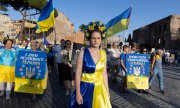
35 years of independence: how is Ukraine faring?
Ukraine marked its 35th Independence Day on Monday, five years into the Russian war of aggression. The leaders of numerous supporting countries travelled to Kyiv for the occasion, with the EU pledging further financial aid running into the billions. Commentators describe a country that has not given up hope of a free and peaceful future.
Withstanding the toughest of tests
Spotmedia states:
“Ukraine's track record cannot be reduced to war, corruption and failure. It also encompasses state-building, the holding of free elections, civil society activities, a cultural renaissance and modernisation achieved under enormous internal and external pressure. Thirty-five years after declaring independence, Ukraine is no longer just a former Soviet republic trying to find its way. It is an independent European state with serious problems that remain unresolved, but also with institutions, an identity and a society that have withstood the toughest of tests.”
Full backing – also in our own interest
Gazeta Wyborcza expresses solidarity with Ukraine:
“In 1991, Poland was the first country to recognise Ukraine's independence. ... We stood by our neighbours during the Orange Revolution in 2004 and, ten years later, during the Euromaidan. We supported them when Russia seized Crimea and part of the Donbas from Ukraine in 2014, and again in 2022 when it launched a criminal, full-scale war. ... Even as dark clouds gather, we will continue to do so. We will demand support for this country which is fighting for its freedom and condemn the malicious, xenophobic campaign against Ukrainians living in Poland. For Ukraine's victory in the war against Russia is of crucial importance to Poland's fate. ... All the best, Ukraine!”
Bleeding but unbroken
Political scientist Linas Kojala explains on LRT:
“People are not entirely satisfied – and not just because of the war. The majority believe the country is heading in the wrong direction, and corruption remains one of the most pressing domestic issues. However, criticism of corruption or political decisions does not imply any doubt about the state's general course. On the contrary: it is precisely the expectation of living in a European state that creates higher standards and thus provides fertile ground for reforms – especially as the orientation towards the West is clearer today than ever before. The majority of Ukrainians support membership of the EU and Nato. ... The evaluation of this Independence Day is therefore mixed. Ukraine is being ravaged and is bleeding – but Russia has not achieved its most main goal: to undermine the very idea of Ukrainian statehood.”
Funding from the West is essential
Público stresses the importance of international solidarity with Ukraine:
“Travelling to Kyiv – as António Costa, Emmanuel Macron, Andy Burnham and Friedrich Merz did this Monday – to mark the day Ukraine celebrated the 35th anniversary of its independence is no longer a risky political move but an opportunity to deliver pledges of support and funding. ... Bringing this war to an end – a war that neither Ukraine is losing nor Russia is winning (or vice versa) – depends less and less on a new 'wonder weapon' and more and more on the ability to sustain people, industry and technology. ... That is why money is so essential for Ukraine, and why sanctions are such an important weapon for weakening Moscow.”
Europe alone stands by Kyiv
La Repubblica takes a look at the status quo on international support for Ukraine:
“Russia has treacherously invaded Ukraine, thereby breaching the commitments it had made to Kyiv, France, Germany and the UK, as well as to the United States. China is openly and explicitly allied with Moscow in this act of aggression. ... Trump has suspended all military support for the Ukrainian fighters. Zelensky can purchase American weapons at high prices. But when he needs them most – as is the case now with the Patriot missiles to defend against Russian bombardments of civilians – the promised weapons are not arriving. Consequently Europe, including the UK, has been left alone to support beleaguered Ukraine against the rest of the world.”
Reforms only came after major upheaval
Although it's taken some time, Ukraine has achieved impressive things in the 35 years of its independence, Ukrainska Pravda puts in:
“The state emerged from the grip of an authoritarian regime that had nearly suffocated it, and, having barely recovered from its illness, learned to walk again. It handed back money and powers to local authorities, established transparent procurement procedures, overhauled the banking system and restructured the army so fundamentally that the next invasion came up against an entirely different country to the one it encountered in 2014. ... However, none of these steps was taken of the state's own political will, but rather in the midst of upheaval, under pressure from the Maidan, the front, the Western partners and disaster.”
Election debate is an expression of freedom
Fierce controversies are part and parcel of democracy, Ilta-Sanomat stresses:
“Ukraine's Independence Day is being overshadowed not only by Russian attacks but also by domestic political disputes. Mykhailo Fedorov, the former defence minister who was sacked by President Zelensky, is proposing that elections be held even though the country is at war. Fedorov has also raised sensitive issues such as corruption within the administration and a ruling elite that rewards loyalty rather than competence. Yes, questioning the president's political legitimacy in the midst of war carries risks. On the other hand, raising difficult questions for public debate is a good example of what Ukraine is fighting for: its freedom and its democracy.”
Independence can't defend itself
Former chief of the General Staff Valerii Zaluzhnyi, now ambassador to the UK, describes in NV the mistakes that have been made since 1991:
“The most tragic mistake of that time was to believe that the freedom we had won in the maelstrom of history would protect itself through that very same maelstrom. It fell to us – those of us who were eighteen in 1991 and believed in the elite of the time – to correct their mistakes with our own blood in 2014. But history will tell whether these were actually mistakes or merely part of someone's plan. In any case, the neglect of the state's protection and defence became the key contributing factor that ultimately made this large-scale and bloody war possible in the first place.”