
New Duma: do the Russians have a choice?
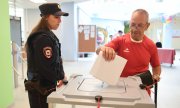
Voting in Russia's parliamentary elections began on Friday morning. Over the course of three days, voters will elect the 450 members of the Duma, 39 regional parliaments and eleven governors. It is already taken for granted that the ruling United Russia party will emerge as the winner. Yabloko, the only party to openly criticise Russia's war in Ukraine, was barred from the election.
Not a hint of debate or competition
For The Moscow Times, this election has nothing to do with democracy:
“The 2026 Duma election campaign has shown that the state system in Russia has completely lost its flexibility and, faced with an ambiguous situation, will simply tighten the screws rather than employing political strategies. It is literally forcing the Russian population to ignore the elephant [the war] in the room. ... The system has become so unaccustomed to debate and competition that it did not even deem it necessary to mimic these hallmarks of the electoral process. ... The war has once again become the number one issue for Russians. And the only political party that dared to include an anti-militarist agenda in its manifesto was barred from the election at the federal level.”
A measure of apathy
TVNET asks:
“Why hold 'elections' in Russia at all, if the desired outcome is already a foregone conclusion? By holding 'elections', the Kremlin can, for example, gauge the actual level of voter turnout. A very low turnout points to apathy among the population, and an apathetic population is potentially dangerous for the Putin regime's political system. With 'elections', the Putin regime creates the illusion of its own legitimacy.”
Ritual spectacle
Political scientist Sergei Medvedev explains on Facebook:
“Elections give regimes the appearance of enjoying popular support; they demonstrate to the population and the elites the dictator's power and his ability to mobilise resources. ... Yet in Russia, with its traditional style of exercising power, elections serve yet another function: they are a ritual that gives a familiar rhythm to life, normalise events – be they war, famine or repression – and bestow upon the state a 'mandate from heaven', as they used to say in imperial China. ... Today, Russia has returned to its Soviet past: elections are a ritual spectacle that play a key role in legitimising the authorities.”
On the path to a war parliament
La Stampa predicts a militarisation of the Duma:
“The winner, the president's United Russia party, was already fixed before the election date had even been set. ... What is likely to emerge from these three days of voting is a war parliament which will not only – like the outgoing Duma – pass every repressive law or hike in military spending without debate, but will also consist mostly of men in uniform. ... A parliament that also marks a shift in the Russian political class itself, or at least in the Kremlin's intentions, and whose main task will be to facilitate the definitive militarisation of society and the economy, beginning with a mobilisation that many Russian and Western commentators consider imminent.”
No meaningful options
Economist Vladislav Inozemcev writes on Facebook:
“Tomorrow, an 'electoral event' will begin in Russia, designed to once again legitimise the Putin regime and demonstrate to the world the population's support for this regime. The closer we came to this spectacle, the more heated the debate has become amongst Putin's opponents – an uncompromising debate, as usual in our circles – on how to express our protest against the Kremlin's actions. Some suggest ignoring the event; others call on people to vote for any party other than United Russia; still others believe the best option is to make sure the ballot paper is invalid. In my view, all these options are pointless in terms of their outcome and therefore equally valid.”