
Xi visits Trump: real rapprochement between US and China?
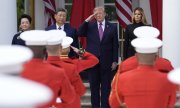
China's President Xi Jinping was received with great pomp by Donald Trump in Washington last week. Both sides emphasised the "friendship" and "progress" in their relations. It was announced today, Monday, that an agreement had been reached on tariff cuts totalling 30 billion dollars and the establishment of a trade council to meet at regular intervals. A forum for dialogue on regulating AI is also to be set up.
When professionals meet amateurs
Expresso says US foreign policy is dilettantish:
“Donald Trump welcomed Xi Jinping in person at Andrews Air Force Base. This breach of diplomatic protocol at the start of the CCP leader's state visit was telling. ... Xi arrived in the US after a lengthy international diplomatic tour aimed at reinforcing the impression that Beijing – unlike Washington – is a stable capital led by experienced professionals who understand the world. In contrast, the American capital is teeming with ignorant, unprepared and arrogant amateurs.”
Trump puts on a show, Xi benefits
Trump has gained little from all the fanfare surrounding his meeting with Xi, The Times comments:
“If the summit bought time for both sides, it is likely China will benefit from the breathing space more. Its exports continue to dominate the world economy (its trade surplus is forecast to exceed 1trn again this year) and its advanced technologies are catching up fast. By comparison, Trump continues to be mired in a war that he did not need to start. Pageantry can matter in diplomacy but Xi was never the kind of man to be swayed by it alone.”
Preserving the cold peace
For Radio Kommersant FM, the main purpose of the meeting is to avert a hot conflict between the two superpowers:
“Xi Jinping did not travel to the US to divvy up the world, but to try to prevent a new Caribbean crisis. ... Trump regards him as a serious adversary, practically his equal. While each has their own, in many respects conflicting interests, both sides are making it clear that they do not want a confrontation. In other words, the most important outcome is the preservation of the status quo, the 'cold peace', to prevent it from turning hot. And by all accounts, this has so far proven successful.”
Maintaining stability while leaving problems unsolved
Delo sees no progress:
“Xi yet again spoke at length about the strategic stability that is to be achieved between the major powers. But this doesn't solve any of the problems. Since his meeting with Trump in May nothing has changed in the deadlock on the Ukraine crisis, the Iran crisis and all the others on the long list of global flashpoints. Once again, the two leaders met not to resolve dangerous conflicts, but mainly to agree on which of them must not add fuel to the fire in which of these conflicts.”
Handshakes rather than genuine agreements
Substance is of secondary importance in the relations between the two leaders, The Economist notes:
“The most consequential aspect of the relationship between Mr Trump and Mr Xi might be the frequency of their meetings rather than the substance of what is agreed. ... The two leaders could meet four times in 2026. The lure of each subsequent meeting gives each side an incentive to keep ties on an even keel. America has delayed a planned 14bn arms package for Taiwan to avoid disrupting the meeting with Mr Xi. ... But the drumbeat of summits might now keep the package in perpetual abeyance.”
Personal versus pragmatic
The Corriere del Ticino describes the two leaders' different approaches to the talks:
“Donald Trump has staked everything on his personal relationship with Xi, heedless of the misgivings of the Maga right and the unease expressed by many Republicans in Congress over the triumphant reception given to the General Secretary of the Communist Party of China. Xi Jinping, on the other hand, adopted a purely political line of argument, stating that the focus was not on individuals – who are destined to change – but on 'nations and states', whose interests are nevertheless 'closely intertwined'.”
Bilateral summits ousting forums
La Vanguardia notes that bilateral meetings are increasingly replacing international dialogue:
“The meeting between Donald Trump and Xi Jinping was the highlight of a whole series of meetings held on the fringes of the UN General Assembly in New York. ... The meeting illustrates how bilateral diplomacy is gaining ground over the forums and bodies in which international dialogue has taken place until now. ... While the major bilateral conflicts remain unresolved, both leaders observed the necessary protocol to stabilise their fragile relations. A lot of symbolism and mutual praise, but little progress.”