
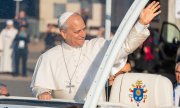
Pope Leo XIV in Metz: pep talk for Europe
In Metz, on the last stop of his France tour, Pope Leo XIV stressed the importance of Europe and its fundamental values for "maintaining peaceful relations". He called for dialogue, courage in negotiations and multilateralism and also paid tribute to Robert Schuman, one of the founding fathers of the EU who worked in Metz for many years. Commentators examine the background to this encouraging speech.
A significant speech in a symbolic place
This Pope is a true advocate for Europe, says El País:
“Robert Prevost delivered the most significant speech of his visit to France in a region of great European symbolic significance, where Europeans fought one another for centuries and then, after 1945, founded what would later become the EU. ... In Metz, Prevost spoke out against an extremist mentality that opposes the process of integration, spreads xenophobic messages, revives extreme nationalism and, in doing so, appropriates Christian values to defend a Europe it claims is facing its demise. This ideology is a perversion of Christianity, as Prevost demonstrated by referring to [Robert] Schuman, whose Christian upbringing instilled in him 'the value of equality, without distinction of race or class'.”
American in the best sense
The Frankfurter Allgemeine Zeitung sees a certain irony in the history of the papacy:
“It seems that for Europe to be rehabilitated, a citizen of the United States had to become the head of the Catholic Church. The pope's visit to Metz to honour one of the founding fathers of today's EU – indeed, his entire trip to France – was a declaration of commitment to Europe the likes of which his predecessor Francis would have never expressed. ... What's more, his words conveyed confidence and appreciation. ... Leo comes across as pragmatic – American in the best sense of the term – when he calls for a 'creative rediscovery' of European values. That said, Leo also left open the crucial question of what such a rediscovery might entail.”
The pontiff's vision
This is all about human dignity, La Stampa writes in praise:
“The gentle Pope, who at the start of his pontificate was accused of showing less empathy than his predecessor Francis, is winning over the cradle of 'laïcité'. In the secularised capital of a nation long considered lost to the Catholic cause, Robert Prevost has overturned the stereotypes and was welcomed by a sea of people as if he were a star. ... The Pope does not question the distinction between the religious sphere and state institutions, but calls for what he terms 'just secularism'. ... A vision rooted in the tradition of social doctrine: ... No freedom, no social security and no progress can be considered authentic unless they recognise the inviolable value of the person.”
Surprisingly popular
No one in France had anticipated how many people would want to see the pope, writes Tygodnik Powszechny:
“Catholicism remains France's largest religion (12 percent of the population are practising Catholics), yet its influence has been waning for half a century. The Church is losing its dominant position to Islam, which is growing rapidly. Religion is a private matter in France, and the separation of church and state is strictly enforced. That is why the huge crowds that turned out to welcome the Pope came as a surprise to everyone.”
An unambiguous message
The Pope's message is a secular one, Corriere del Ticino points out:
“Robert Prevost interprets events and historical reality according to the model of the two cities: the City of God, which is eternal, and the earthly city. ... Under Leo XIV, the Church lives in the earthly city but acts according to the rules of the City of God: it does not propose a political programme, but offers reflections on the fundamental issues affecting humanity. The four-day Apostolic Journey to France, which ended yesterday with an appeal to Europe and a solemn Mass in Metz, has confirmed this approach. The pope does not enter into political debate, and leaves no room for potential exploitation of his words. Yet he will not be deterred from delivering his message, which is marked by strong and at times unambiguous undertones.”
A model for politicians to emulate
The papal visit has had a salutary effect for France, La Tribune writes:
“The huge crowd gathered on the Champs-Élysées illustrates the impact and emotional power of this papal visit. The fact that a pope who champions peace, refugees and those forgotten by capitalism inspires such hope is cause for celebration. He is presenting himself as a man of goodwill at a time when the warmongers and sorcerer's apprentices of the tech world pose a threat to the very dignity and greatness of humanity. Leo XIV may not succeed in halting the decline of Christianity in France, but he has helped to make our country more humane. ... If the presidential candidates prove receptive to this aspect of the papal message, Leo's journey will not have been in vain.”
Striking a chord
The pope's message of peace, diplomacy and inclusion is going down well even in secular France, comments The Irish Times:
“Just days after the UN General Assembly, he reprised important themes of its discussions, echoing an insistence on multilateralism and building peace through diplomacy and reiterating long-standing Vatican opposition to nuclear weapons. ... Despite its secular ethos and the rise of the French far-right, the Pope's message of peace and inclusion and his linking of the church's teachings to current events and themes – including artificial intelligence – clearly found favour with large numbers of the French public.”
Following in Schuman's footsteps
Leo XIV is sending an important message about the importance of European integration, Rzeczpospolita writes:
“The pope will conclude his pilgrimage through France in Metz. This city is associated with Robert Schuman, the foreign minister who on 9 May 1950 presented his plan for the establishment of the European Community. This date is regarded as the beginning of European integration. With this gesture, the Pope hopes to counter populist nationalism and emphasise the importance of the EU. If the polls are to be believed, the far-right candidate Marine Le Pen could win the race for the Élysée Palace in seven months' time. ... The Church has initiated the beatification process for Schuman, who lived near Metz and whose ashes rest in the nearby fortified church of Saint-Quentin.”
Leo not avoiding subject of abuse
This pope is taking the fight against abuse seriously, La Stampa notes:
“At first glance, the meeting between Leo XIV and the victims of clerical abuse – seven people in this case – took place discreetly, in accordance with protocol. What was different this time, however, is that it took place in France, the country where, on the initiative of the Catholic Church itself, the most thorough independent investigation ever conducted on the subject of abuse was carried out and published in 2021. ... An example that has not been followed by the Italian Church – facilitated by Pope Francis's decision back then not to grant an audience to the authors of the French inquiry, despite their express request for him to do so.”