
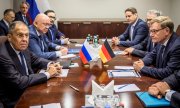
Wadephul meets Lavrov: a good idea?
For the first time since January 2022, the German and Russian foreign ministers met in person on Saturday on the sidelines of the UN General Assembly. However, there was apparently no convergence of positions during the 20-minute meeting between Sergey Lavrov and his German counterpart Johann Wadephul. The media discuss the diplomatic efforts aimed at resolving the war in Ukraine.
Bad timing
The Frankfurter Allgemeine Zeitung says the meeting was pointless:
“No positive outcomes, no willingness to negotiate, not even any talk of concessions along the lines of the previous grain deal brokered by Turkey. Only Lavrov came away with anything to show for his efforts: handshake photos and the opportunity to mock Germany's chief diplomat. ... 'At some point' we will have to talk to one another, Wadephul argued. But now, of all times, when Moscow has quite rightly been identified as the instigator of dangerous attempted attacks? This is not just any point in time; it is the wrong one.”
Germany must secure a place at the table
The Süddeutsche Zeitung says that despite the lack of results the meeting was not a mistake:
“After all, it showed that Moscow has no intention of negotiating. Those in Germany calling for more dialogue with Russia now have proof of this. The AfD should finally take this on board: Russia uses every outstretched hand as a stage to make the West appear divided and weak. ... With Donald Trump in the White House, we have a US president who sees Russia as a 'very valuable country' that would be 'great for business'. Germany must secure a seat at the negotiating table between Washington and Moscow. Twenty minutes can be a start, but nothing more.”
Energy market as key pressure point
Radio Kommersant FM assesses the talks on the war in Ukraine taking place on the sidelines of the UN General Assembly as a whole:
“There may well be some progress, but the parties involved prefer not to reveal their hand for now. ... The issue of an 'energy ceasefire' remains on the agenda. It's no secret that Donald Trump is openly interested in this because he wants to stabilise global market prices for both crude oil and diesel. It's fair to say that this factor is significantly increasing the pressure on both Moscow and Kyiv. Especially as the US President now has a trump card in the form of 'hellish sanctions' – the 'Graham Sanctions Act against Russia and Iran' – which he can play at any time.”