
Ukraine talks: is peace any closer?
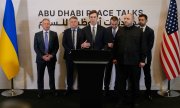
Russia and Ukraine have agreed in Abu Dhabi to a major prisoner exchange, brokered by the US.US envoys Jared Kushner and Steve Witkoff will visit Russian President Putin in Moscow on Thursday, before meeting Ukrainian President Volodymyr Zelensky in Dublin. EU representatives were present in Abu Dhabi but did not take part in the negotiations. European media take a closer look.
A schizophrenic situation
Delfi can't understand why Europe is not involved in the negotiations:
“The situation is schizophrenic, because Europe is not at all powerless. We have sanctions against Russia that are working, and we provide a significant share of the financial and military aid to Ukraine. ... Our role is therefore strategic, yet Europe has so far been unable to behave accordingly – that is, to leverage its strategic clout at the political level. And as a result we now have this farce in which 'discussions' are held and Europe's 'security architecture' is negotiated. Europe must first agree on what its demands are, what it will not compromise on, and who is authorised to speak on its behalf.”
Putin won't stick to agreements
The Tages-Anzeiger is sceptical about the prospect of peace:
“There may eventually be a ceasefire, and the conflict on the front line may be frozen. Putin, however, will not feel bound by any agreement that falls short of his goal of a neutral, defenceless Ukraine and a Nato withdrawal. That is the greatest threat to Europe. And another reason why Putin won't be satisfied is that the cost of his war is already much higher than expected at the outset. The war will not only leave Russia weaker, but possibly also with a new sense of insecurity. This is the result so far: Ukraine is further than ever from becoming a neutral buffer state, Nato has grown by two members, and Europe is rearming.”
Cynical deal instead of a fair solution
Political scientist Alvydas Medalinskas remarks through gritted teeth on LRT:
“While beleaguered Ukraine can be reduced to rubble and ashes and Russia is suffering severe economic damage, a peace is becoming possible that would probably no longer have to be described as 'Trump's peace' but rather as the 'Trump-Putin peace'. After all, Trump would still need a few more years to finalise his 'deals' in the Arctic and Siberia. So even something as precious as peace is viewed with such cynicism these days. ... For us in Lithuania who are following these developments with concern, it is now a matter of ensuring that the security of the newer Nato member states is not also served up on a silver platter as part of the 'deals' in the Arctic and Siberia. For that is precisely what Putin wants.”
Regional borders are the Kremlin’s sacred cow
Writing on Facebook, political scientist Abbas mocks the Kremlin's obsession with gaining control over the Donetsk region:
“Putin claims that Ukraine is an artificial state with arbitrary borders. At the same time, he demands that the Donbass be handed over to him precisely within the administrative boundaries defined by that very same artificial state. The Russian President's logic is flawed. For him, Ukraine's borders are illegal, yet the borders of its regions are sacrosanct. So sacrosanct, in fact, that hundreds of thousands of Russians can be sent to their graves for them, month after month, year after year in their defence. Vladimir Medinsky [head of the Russian delegation] spoke again today of 'Russia's historic territories'. It's just odd that he seeks their borders not in history books, but in Ukrainian administrative records.”
Fresh start for Nato-Russia dialogue?
For Adevărul it is possible that US negotiator Jared Kushner wants to revive the Nato-Russia Council, which was formed in 2002 and declared defunct by Moscow in 2025:
“Can they pick up again from the point at which relations between Nato and Russia were put on hold, perhaps in the hope that everything can still be sorted out and that things will return to the state they were in 2002, when, after the end of the Cold War, prospects opened up that were considered unprecedented? Would that, as discreet and extremely well-informed sources sometimes suggest, be a prerequisite for Europe to re-enter the fray in line with its ambitions as a global player?”
Diplomacy to build a secure Europe
Peace researcher Viçens Fisas writes in eldiario.es:
“I propose a European diplomatic initiative for a negotiated peace. ... The first step would be the acceptance that Russia retains the occupied Ukrainian territories – coupled with guarantees for the people living there and those who have been displaced. This pact would include the lifting of sanctions, an international reconstruction programme and humanitarian measures. ... The second would be a European security conference involving Russia, Ukraine, the US, the EU, the UK and Turkey. ... Russia would have to make binding commitments to refrain from aggression. ... This would lay the foundations for a European security order that includes both Russia and Ukraine – rather than pitting one against the other.”