
Trump threatens Spain: should Sánchez hold his tongue?
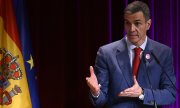
Spanish Prime Minister Pedro Sánchez reiterated his "No to war in Iran!" in a televised address on Wednesday. The day before, US President Donald Trump had strongly criticised Spain in the presence of German Chancellor Friedrich Merz for refusing to allow the US to use two military bases on its territory and threatened to sever trade relations with Spain. Commentators take stock of the leaders' behaviour in this delicate situation.
Madrid showing dignity like a great nation
Spain is saving Europe's honour, historian Salim Lamranin praises in L'Humanité:
“France, Germany and the UK have refused to condemn the war of aggression and in an irresponsible move have even offered their help in stopping Iran's counterstrikes. Trump responded promptly and called on his Secretary of the Treasury to halt all trade with Spain, effectively imposing economic sanctions. But far from being intimidated Madrid reacted with the dignity that characterises great nations: 'The US must comply with international law and trade agreements. We have the necessary resources to mitigate the effects of any embargo.'”
Merz on the wrong side
Merz has let Spain down, Der Spiegel sighs:
“America first, EU second. That was the chancellor's line in Washington. Germany stood by the 'bully', not the victim. ... Pedro Sánchez has been taking a clear line for months, insisting that Spain stands by international law. That applies to Gaza, to Ukraine, and now also to the war in Iran. ... One may consider this naive. ... Nevertheless, Sánchez stands for the principles enshrined in the EU treaties. Respect for jointly agreed rules is the essence of the EU. Sánchez is also holding up a mirror to Germany: do we want to throw our values overboard out of fear of the US president? Merz hasn't provided a convincing answer to this question yet.”
Upholding principles from a safe place
The Süddeutsche Zeitung is unimpressed by Sánchez's steadfastness:
“Apart from the question of whether it is fair to hide behind the Pyrenees on defence policy issues, where one can feel safer than on the eastern edge of the alliance's territory, is it at all wise to risk international turmoil for the sake of securing victories in domestic politics? And possibly also a trade war and soaring inflation? ... In the best-case scenario, the US would have to deal with the whole of Europe. Sánchez should have taken this potential escalation into account before going it alone. With all due respect for his courage and stance, even in private life it's easier to achieve your goals if you don't bang the drum every time you disagree with someone.”
Profiling as the leader of the left
In an article in El País, political scientist Estefanía Molina says Sánchez's statements on the Iran war are motivated by domestic politics:
“The prime minister's goal is to conquer the political space of [left-wing parties] Sumar and Podemos. ... The deterioration of relations with the US over the Iran conflict came at just the right time for Sánchez to consolidate his position as the leader of the left. ... He has decided to use the geopolitical arena to make up for his weakness in domestic politics. Entering into disputes with the techno-oligarchs, presenting himself as the great defender of migration vis-á-vis ICE's operations in the US and challenging the unilateral actions of the US within the UN are all part of the same strategy. ... Even though armed conflicts won't solve the issues of housing and low wages in Spain.”
Iron out the differences
La Vanguardia reminds Sánchez of Spain's economic interests:
“Sánchez is playing for high stakes. ... Since Russia's invasion of Ukraine the US has become Spain's main supplier of oil and gas. ... Now dialogue and appeasement are called for to iron out the differences. We must avoid a confrontation that can't lead to anything positive between allies. It's good that the Spanish government maintains is own position, but it must also be able to count on its European partners. ... It must find a way back to normality. ... Our role in Europe and on the international stage, as well as our economy and our companies' good performance are at stake.”
International law is clear
Der Standard backs Pedro Sánchez:
“International law recognises only two exceptions to the prohibition of violence. Either when the UN Security Council approves military action or a state defends itself against an attack - or an imminent attack that cannot be prevented by any other means. Neither applies to the current actions of the US and Israel. Nevertheless, there are quite a few politicians who show understanding and see international law as an obstacle that must now give way to realpolitik. The current events in the Middle East should, however, be condemned unanimously. Spain's Prime Minister Pedro Sánchez is leading the way: 'No to war in Iran!' With no ifs, ands or buts.”