
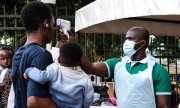
Ebola outbreak in Congo: how to respond?
The Democratic Republic of Congo and Uganda are grappling with an outbreak of the deadly Ebola virus. Several hundred suspected cases and more than 130 deaths have been reported so far, prompting the World Health Organisation (WHO) to declare an international public health emergency. There are no vaccines or treatments for the rare strain of the virus that is currently spreading.
Everyone must pitch in
The global community cannot afford to just stand by and watch, The Guardian admonishes:
“Ebola outbreaks have been controlled in the past, so it's less a knowledge gap and more one of enough staff, PPE, lab capacity and logistics. ... Right now, the DRC and Uganda governments need the world's attention, cooperation and support to get the necessary resources to stop this outbreak. If your neighbour's house is on fire, you don't wait and watch. You help to put it out before the fire spreads to yours. That's the interconnected world we live in, and an important lesson for all politicians watching the crisis unfold.”
Don't make the whole of Africa suspect
The Frankfurter Allgemeine Zeitung warns against cliches:
“There it is again, the image of Africa as a continent of disease, crisis and catastrophe, where no distinction is drawn between the different regions or countries. Twelve years ago, even safari companies in South Africa were financially impacted because of fears about Ebola, despite the fact that Europe is closer to Sierra Leone than South Africa is. The WHO was certainly right to declare this Ebola outbreak an international health emergency. But let's hope that won't mean all 54 African countries are again placed under suspicion of being contaminated.”
Ill-prepared for the next pandemic
The drop in support for aid organisations is having drastic consequences, warns the Financial Times:
“Health systems in poorer countries are having to adjust to lower levels of international aid, which fell by a record 23 per cent last year. The US, hitherto a champion of global public health, is now hostile to the very concept. The WHO has been weakened by the exit of the US, as well as Argentina ... The US Centers for Disease Control and Prevention, which has previously played a leading role in containing epidemics, is in turmoil thanks to swinging cuts by a Trump administration. ... Globally, six years after the shock of Covid-19, attempts to prepare for the next major pandemic have been slow.”
Fill surveillance gaps
Polityka argues that infection surveillance needs to be more effective:
“This doesn't mean the world is on the brink of a new pandemic. Ebola is not resurfacing as a virus with pandemic potential, but rather as a warning. Fortunately, despite its enormous media presence, it spreads far more slowly than coronavirus or the flu. But this is precisely why the current situation is causing experts such concern. If even a relatively immobile pathogen can spread on such a scale before being officially identified, it means that there are still major gaps in the epidemiological surveillance systems.”
Focus on facts and science
Pharmacologist Jean-Michel Dogné explains in Le Soir what a sensible response would be:
“Not all viruses are potential Covid viruses. Scientists must continue to provide thorough and clear explanations, acknowledging the uncertainty without oversimplifying matters. Social media platforms can no longer ignore their role in spreading misleading or polarising content. … Andes hantavirus, Bundibugyo Ebola: these names should not trigger panic or fuel delusions. ... Between denial and hysteria, there is a third, more challenging path based on facts, moderation and critical thinking. Yet we continue to collectively ignore this path.”