
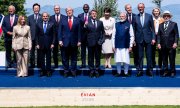
G7 members back on the same page?
The leaders of the G7 countries have agreed on tougher sanctions against Russia and new arms deliveries to Ukraine. The summit's host, French President Emmanuel Macron, described the meeting in Évian as a "moment of strategic awakening", bearing in mind that US President Donald Trump left the summit early last year, thus blocking any joint decisions. For some commentators, however, the newfound unity is illusory.
Golf course diplomacy
Several challenging topics were omitted so as not to alienate the US President, the Neue Zürcher Zeitung observes:
“Instead, the summit conveyed the impression that it was pursuing one goal above all else – to keep the most powerful man in the world on board. Macron pulled out all the stops to ensure that Trump wouldn't leave early. From inviting him to the magnificent Palace of Versailles and making a golf course permanently available for his use to designing a programme that would neither upset nor bore the star guest. From a diplomatic perspective, this is certainly understandable. Following the rapprochement between Washington and Tehran and Trump's announcement that he will do more to support Ukraine, the other leaders wanted to avoid jeopardising the American president's new willingness to engage in dialogue.”
As much as can be expected from this format
El País concludes that things could have been so badly at all:
“Ever since Trump returned to the White House in January 2025, the partners have been trying to limit the damage, and in Évian they were more successful than on previous occasions. ... For Europe, the real progress made in Évian is the commitment to Ukraine and Washington's support for tightening sanctions against the Russian energy sector at a crucial moment in this conflict that has lasted longer than the First World War. With Trump at the table, little more could be expected of the G7 – a multilateral institution founded in the 1970s whose influence, half a century on, is waning. What has been achieved is no small thing, but it's still not enough. Compliance and appeasement cannot be a strategy.”
Pretty good
Les Echos is pleasantly surprised:
“The good news – and this is a personal triumph for Emmanuel Macron – is that the US appears ready to recommit to backing Volodymyr Zelensky, including the delivery of arms to Ukraine and the reinstatement of sanctions against Moscow. Donald Trump may well be telling himself that the Ukrainian warlord belongs on the 'winning side'. ... Even on purely economic issues, the outcome is not a washout. The US President has signed a declaration stating in black and white that there will be no toll in the Strait of Hormuz. Furthermore, concrete coordinated measures are now underway to reduce dependence on China for rare earths and permanent magnets from 80–90 percent to 60 percent by 2030.”
New hope regarding Ukraine
La Stampa is optimistic:
“The G7 summit in Évian has achieved one victory, at least on paper: bringing Donald Trump back on board regarding the war in Ukraine. It was the American President himself who gave his allies cause for hope on the second day of the summit in the spa town on the shores of Lake Geneva: the United States had so far 'focused on Iran', the tycoon commented, adding that bolstered by the deal reached with Tehran to resolve the Middle East crisis, he now intended to turn his attention to the conflict on Europe's doorstep. ... The US President described his face-to-face meeting with his Ukrainian counterpart as 'terrific'. The latter did not rule out another meeting before the end of the summit.”
No easy path to peace
Trump's comment that he would like to focus more on Ukraine again after Iran can also be seen as a threat, writes Der Tagesspiegel:
“He is seeking the easy way out through deals with Putin – without any regard for the consequences for Ukraine and Europe. ... There can only be a lasting peace if Europe realises that Putin will only make concessions when he faces the prospect of military defeat. Agreements with Putin are worthless; he has broken almost all of them so far. The only commitments that will be honoured are those that Europe is willing and able to enforce by military means if necessary. There is no easy path to peace. That is an illusion.”
Adapting to Trump’s childish behaviour
The Tages-Anzeiger criticises those who pander to Trump's whims:
“It's well known that Trump hates such summits: too many people, too many long discussions, too multilateral. So he has to be kept happy, otherwise he'll leave again – or he won't even turn up. That is why the French, among other things, removed climate change from the summit agenda: Trump doesn't like it. He doesn't like development aid either, which is why that was also left out. Everyone puts up with this childish behaviour from the most powerful man in the world. Because he is, after all, the most powerful man in the world, and behaves as such. You mustn't snub him; you don't even contradict him when he lies.”
Time to switch up to G8
The G7 is behind the times as an institution, says The Daily Telegraph:
“It remains a small club of liberal democracies which might possibly have been the seven most significant powers in the world in the 1970s but which can no longer make that claim. ... There have been various proposals to expand by admitting Australia, South Korea, Spain, Indonesia. ... But there is one country which has a more deserving claim to be part of an expanded G8 than any of the above. Saudi Arabia might only just about make it on to a list of the 20th largest economies in the world, but its importance as a power broker outweighs all that. It is clearly the leader of the 'middle powers' in the Middle East.”