
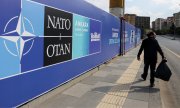
Ankara summit: what lies ahead for Nato?
The leaders of the Nato member states have convened in Ankara. Ukrainian President Voldomyr Zelensky was among the guests and reaffirmed his country's desire to join the alliance. In view of the many challenges Nato faces, commentators take a positive view of the results of the meeting so far.
Green light for surge in defence investment
This Nato summit will go down in the annals of history, România liberă declares:
“The eastern flank is no longer seen as a peripheral region but as one of the alliance's most important lines of defence. The discussions about the Black Sea, drone defence and joint procurement show that the region is becoming increasingly important in Nato's planning. Historians may not remember the Ankara summit for its final declaration. ... They will remember it as the moment when Nato recognised that security can no longer be achieved through political guarantees alone, but that it requires genuine investment, a competitive [defence] industry and the capacity for rapid production.”
Kyiv's strategic upgrade
Nato has upgraded its assessment of Ukraine, writes European Pravda, citing the resolutions from the Ankara summit known to its editorial team at this point:
“The summit's concluding declaration will for the first time officially recognise Ukraine as a 'security contributor' – meaning that it is capable of increasing security in Nato territory. This description had been avoided by the alliance until now, and it is one of the key criteria used to determine whether a state is eligible to join the military bloc. The US has also approved this description, confirming that Trump's stance on Ukraine is gradually shifting.”
Stop Russia's missile terror
Military expert Olexii Kopytko writes a wishlist for the Nato summit in a Facebook post republished by Glavkom:
“Without ballistic missile defence systems, Kyiv will become a shooting range for the Russians – just like all the other cities in the north, east and south of Ukraine. Nato's leadership must somehow take action to prevent this. In addition to ensuring the rapid delivery of missile defence systems to Ukraine and ramping up their production, there are at least two other options: consistent enforcement of sanctions already agreed upon – as Russian missiles still contain numerous Western components – and support [for Ukraine] in scaling up production of long-range weapon systems, so that by autumn 1,000 deep-strike weapons of all types can hit targets in Russia every night.”
Europe needs more than good intentions
It's high time Europe put its money where it's mouth is on defence, Le Soir demands:
“European leaders must step up their efforts. The US keeps sending messages and signals about pulling back, especially when it comes to withdrawing troops from Europe. ... And this in spite of the warnings from intelligence services about a possible Russian attack on one or more Nato members by 2030. And in spite of the ongoing war in Ukraine. ... Yes, a year ago the Europeans did commit to upping their military spending and investment. But these good intentions are struggling to get off the ground. ... The coordination between European capitals is failing to materialise or has failed already – as was the case with FCAS, the Franco-German airforce project.”
US is the not the only problem
Helsingin Sanomat is concerned about unity within a European Nato:
“Although there is greater willingness across Europe to increase defence spending, Nato cannot be Europeanised without conflict. Trump's erratic alliance policy, Erdoğan's authoritarian government and the differing levels of support among Nato countries for Ukraine are just a few examples of how difficult it is even for Europe to establish a common security policy. The persistent threat from Russia means that Nato's eastern flank is a cause for concern. For Finland, it is not only the US that poses a problem, it is also the question of whether all European states will share political and military responsibility for collective defence.”
Germany as new central power
The old Nato is long dead, comments the Süddeutsche Zeitung:
“And everyone knows it. The withdrawal of the United States has begun and is, at least in part, irreversible. ... It is no longer a question of distributing the burden more evenly. Mutual assistance will have to be guaranteed to a large extent by the Europeans. The role of the US will increasingly be limited to that of a reinsurer, albeit an indispensable one, particularly in the nuclear sphere. Whether this model will function at all depends, apart from the US, essentially on one member state: Germany. This follows from a process of elimination. If we look at size, economic clout and geographical location, only Germany remains as the potential centre of the new Nato.”
Erdoğan can show off
The Turkish president can make the most of this opportunity to play the strongman, both domestically and internationally, comments SRF correspondent Sebastian Ramspeck:
“Erdoğan is using the summit to flex his muscles. Turkey has a rapidly growing arms industry, it has Nato's second largest army and controls access between the Mediterranean and the Black Sea. It was also one of the few countries that was able to mediate between Russia and Ukraine. On the domestic front, this show of power is taking the form of repressions: shortly before the summit critics of Erdoğan were arrested, demonstrations were banned and oppositional media was denied access to the event.”
Watch out for Ankara
Phileleftheros warns:
“Turkey remains interested in its European prospects, even though it knows it will not become a full member. ... But even to take any steps in this direction it must change its behaviour and work towards resolving the Cyprus issue. ... So it came as a surprise when the EU's High Representative for Foreign Affairs and Security Policy, Kaja Kallas, described Turkey last week in Ankara as 'a key partner on security, migration, and energy, as well as an EU candidate country'. Such statements are really not helpful. On the contrary, they encourage Ankara to not back down. Is that really what they want?”
Czech Republic not pulling its weight
The Czech Republic will have to face accusations in Ankara that it is neglecting its Nato duties, fears Reflex:
“The main focus of this summit is how Europe can strengthen its security. And this is directly linked to how much the member states spend on defence. The Czech Republic and the government of Andrej Babiš have failed to provide a satisfactory answer to this question. For the simple reason that we spend too little on defence and our contribution to European security is therefore inadequate. ... If there's one area at this summit where Andrej Babiš will pull out all the stops, it will be in his efforts to secure photos or videos of himself with Donald Trump and Emmanuel Macron. ... But that is woefully insufficient. And it certainly won't strengthen the Czech Republic's defence and security.”
Start thinking about shared custody
The time has come for a mature discussion on mutual relationships, says De Morgen:
“It is in the interests of both the European Nato members and the US to establish at this summit exactly what Nato 3.0 should look like and who does what when it comes to the crunch. Let's stop giving the impression that there is still a unified, close alliance; instead, let us strive for an optimal long-distance relationship, with a clear timetable for a divorce settlement where necessary, and joint efforts in those areas where this is still possible.”
Those who pay more can demand more
El Periódico de Catalunya comments on how Europe's role in Nato has changed:
“The European Nato member states have increased their defence spending. By 2025, military spending by European countries had risen by 20 percent – far more than in China and three times as much as in Russia, despite the war in Ukraine. ... The European position has prevailed on two key issues: Ukraine and Iran. The Ankara summit must therefore result in an alliance with more European input, with a more multipolar character and with greater respect for the rules. Those who pay more can demand more.”
No time for passivity
EU correspondent Valérie de Graffenried calls in Le Temps for Europe to be more assertive:
“Is giving up all ambition in order to preserve a facade of unity really a viable strategy? Europe can certainly no longer hide its vulnerability in the face of Donald Trump's unpredictability, which regularly undermines transatlantic relations. And all too often, it gives the impression of merely passively accepting developments. Yet the real challenge for Nato is no longer to simply cope with Donald Trump but to demonstrate that its cohesion, credibility and deterrent capability do not depend on the whims of a single US president.”
Meloni an easy target
Italy's Prime Minister won't have an easy time at the the summit, Corriere della Sera explains:
“Giorgia Meloni faces a twofold and difficult challenge at the Nato summit. ... Like all European leaders, first and foremost she will have to deal with Donald Trump. Diplomats – particularly the Americans – are expecting the President's next solo appearance to be eccentric and reckless. He is likely to lash out at those allies who he says failed to support him in the conflict with Iran, while at the same time criticising those governments which in his view are still spending too little on defence. The government led by Meloni falls into both categories and is therefore – along with the Spanish government under Pedro Sánchez – particularly exposed to Trump's wrath.”
Kyiv needs more missile defence
One of Kyiv's key expectations for the Nato summit is that the decision will be taken to strengthen its defence capabilities against ballistic threats, 24tv.ua writes:
“It's no longer enough just to discuss new aid packages every few months – long-term solutions are needed. Joint arms production, licences to manufacture modern air defence systems, stepping up the production of Patriot missiles and new mechanisms for funding the defence industry – all this can help Ukraine not only to hold its ground in the war against the Russian aggressor, but also to inflict significant defeats on it and defend its own cities. The latest massive attack on the capital has shown that we have problems countering Russian ballistic missiles, proving that we cannot manage without support on that front.”