
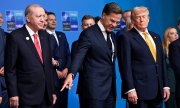
After Ankara: is Nato a united front again?
Nato members made a show of unity at the end of the summit in Ankara. The final declaration states that Europe and Canada will shoulder a greater share of the defence burden in future. Plans were drawn up for massive investment in the defence industry and the modernisation of member states' armed forces. Military aid totalling 140 billion euros over two years was also pledged to Ukraine. The media takes stock.
An alliance with potential
The Süddeutsche Zeitung looks to the future with cautious optimism:
“It's looking as if the Nato that will exist when Trump leaves the White House in 2029 will be a better one than the Nato that existed when Trump took office for a second term in January 2025. Better in the sense of militarily and politically stronger. It will – or it could be – a Nato in which Europeans' genuinely unhealthy dependence on the Americans is less blatant. ... Because the Europeans will have learned to think and decide for themselves when it comes to security policy. And because they will have built armies to defend themselves. ... Does that sound too optimistic. Not necessarily. It is the path that Nato is currently walking.”
Shared responsibility on the Black Sea
Romania should be satisfied with the results of the Nato summit in Ankara, according to the Romanian service of Deutsche Welle:
“Because firstly, all three allied neighbouring states [Romania, Bulgaria, Turkey] on the Black Sea coast will be working together to defend their coastlines in future, thus sharing responsibility. Secondly, by joining new defence consortia with ten other countries, Romania will be able to intercept Russian drones before they enter its airspace. ... And lastly, the summit's final declaration mentions 'unwavering support for Ukraine', a promise that will also benefit Romania, which has a long border with Ukraine.”
What 3.0 could stand for
ERR describes the key outcome of the Ankara summit is the beginning of a European era in the alliance:
“The summit in Ankara could go down in history as the moment when it was decided that Europe would take over the leading role in the alliance from the US. The US is gradually reducing its conventional military presence in Europe, while retaining, above all, the nuclear deterrent. This is being called Nato 3.0. Nato 1.0 was the Cold War and 2.0 was Afghanistan. It must be said straight away, with regard to this reduction in conventional military presence, that the situation is not yet entirely clear, as the audit has yet to take place. Nobody knows what might happen in the meantime.”
Unity amid turmoil
Political scientist Linas Kojala provides a recap in Delfi:
“The Nato summit ended with something that we can no longer take for granted: unity. This does not mean there are no more tensions within the alliance. ... The political atmosphere remains turbulent, even chaotic. But the key message remains: no matter how tumultuous the situation, Nato will find a way forward. America's signature on the final declaration signals that the US does not wish to withdraw completely, despite the shift in responsibilities within the alliance. ... All the predictions about 'the death of Nato' are greatly exaggerated.”
Trust destroyed long ago
But Handelsblatt observes that very little remains of what Nato once was:
“Yet again, the irascible president has made no secret of his contempt for the transatlantic partners – no matter how much the Europeans might try to placate him. ... So we are left asking how much remains of the Western defence alliance, when no one this side of the Atlantic can trust the Americans' commitment to it. The mutual defence obligation under Article 5 is a fragile seedling that is less rooted in a Nato Treaty clause than in the trust between partners who once shared the same values. That trust, however, has long since been destroyed.”
Europe stronger thanks to Trump
El Mundo is satisfied with the outcome:
“The Nato summit in Ankara has concluded with more positive than negative results. At a time when Donald Trump has repeatedly threatened to withdraw the US from the transatlantic alliance, it has managed to preserve its political unity, at least for the time being. The most important benefit for Europe is that it has bought time to continue rearming without being abandoned by its main protector to face the existential threat of Russia alone. … Trump is and will remain a constant source of uncertainty. This forces Europe to pursue, with more resolution and speed, the path of political unity and military autonomy promoted – paradoxically – by Trump.”
Alliance of military fanatics
Avvenire is deeply worried by the new obsession with militarisation:
“The poster boy for this is Mark Rutte. He nods enthusiastically when Donald Trump takes credit for new strikes on Iran. He smiles approvingly when the tycoon lays into Spain, despite it being a member of the alliance. And above all, he speaks about a trillion-dollar arms deal with an almost boyish enthusiasm. He waxes lyrical about next-generation ammunition, drones, frigates, missiles… But Rutte is merely the tip of the iceberg of a brand of fanaticism that is proving difficult to contain. Even the leaderships of European institutions are not holding back. ... It's as if all awareness of the gravity of the issue and of the historical moment in which we find ourselves has been completely lost.”
Endless opportunities for Turkey
Ankara's real achievement at the summit is not diplomatic but economic, Milliyet writes:
“Because in the new neo-mercantilist era, security and economics have become inseparable. The arms industry, technology, energy, artificial intelligence and supply chains are now all interlinked. If Turkey can stay ahead of the game in this transformation and convert its geopolitical advantage into an economic model that produces high-tech goods, boosts exports and moves up the global value chain, the truly lasting benefits of this summit will be economic, not diplomatic.”
Zelensky has raised the bar
Ukraine scored big time at the summit, notes Corriere della Sera:
“A year-and-a-half ago Volodomyr Zelensky was humiliated by Donald Trump and J.D. Vance in the White House. ... The Ukrainian people, their armed forces, and their technological ingenuity have since shifted the balance of power on the ground – and such things always make an impact on Trump. The Pentagon was the first to see that Ukraine was a strategic resource, and became a customer of Kyiv in order to secure knowledge in the drone sector. ... In Ankara, Trump even went so far as to suggest granting a licence that would allow Ukraine to manufacture Patriot interceptor missiles domestically. ... This is a remarkable turnaround.”