
Ukraine negotiations: reshuffling the deck in Europe?
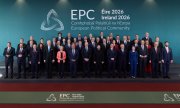
This week's Ukraine peace talks in Abu Dhabi have ended without a major breakthrough. The heads of state and government attending the European Political Community (EPC) summit in Dublin on Thursday discussed further support for Ukraine. The US has held out the prospect of European involvement in future negotiations. Russia is calling for a comprehensive agreement on the European security architecture.
Legitimate concerns
Although Russia and the US want the Europeans at the negotiating table on Ukraine, their goal is to discuss far more than the fate of that one country, warns Hospodářské noviny:
“'It's going to involve more than Ukraine, and I could even say it might involve all of Europe,' Trump said. Russian Foreign Minister Sergey Lavrov reiterated Moscow's long-standing demand that there is no point in considering a ceasefire until a comprehensive agreement on the security arrangements in Europe has been reached. ... At the heart of these demands lies the de facto reversal of Nato's eastward expansion into countries that belonged to the Soviet sphere of influence prior to 1989. ... Nato would be split into two parts. East of Germany it would cease to be a military alliance and become a purely political one. ... This would fundamentally weaken its ability to stand up any further Russian demands.”
Turning the clock back 30 years
Russia in particular can chalk up the negotiations as a success, writes Rzeczpospolita:
“The country has succeeded in calling into question the principle that we can only discuss business and future peace once the war is over. The war is still raging yet Russia is already exporting its diesel, while the negotiators from Moscow have managed to turn the clock back 30 years. For Poland, the mere fact that this issue has been brought to the negotiating table is a disadvantage. The same applies to Medinsky's remarks that the post-Yalta order in Europe is untenable. Especially since Putin's adviser has explicitly called for a 'new Yalta and Potsdam'.”
Council President Costa should represent the EU
The EU treaties provide a simple answer to the question of who should represent the EU in peace negotiations, Der Standard notses:
“It remains to be seen what weight should be given to Jared Kushner's statement that from the US perspective there can be no solution without the Europeans. ... The EU member states are deeply divided among themselves regarding the joint financing of aid for Ukraine, and also on the question of who should lead the bloc's delegation in the negotiations. The simplest solution is laid down in the EU Treaties. The highest-ranking representative of the Europeans is the permanent President of the European Council, António Costa. In terms of realpolitik, however, France and Germany will call the shots regardless.”
No one can trust Moscow anymore
Political scientist Ilya Matveev explains in a Facebook post that Russia is unfit as a partner for security agreements:
“By invading Ukraine, the Russian Federation has triggered a new Cold War, and defence spending will now be the sole measure of 'security' in Europe. No new treaties can improve Russia's situation – at least not as long as Putin remains in power, and most likely not even after there are political changes there. For there is absolutely no trust in Russia. Russia has consistently violated all international treaties and declarations. Who, after all that, would still want to play 'collective security in Europe' with it? You only have as much security as you have soldiers and drones (and, in the future, nuclear warheads).”
A costly peace is also a gain
Peace would certainly be in the population's interest, says Maszol:
“There is a consensus that it would represent an enormous victory for the Kremlin's strategists if Ukraine were forced to make territorial concessions. But who would stand to gain the most from peace? It would be the Ukrainian, Hungarian and Romanian men and fathers with Ukrainian citizenship, or those with Russian citizenship, who don't end up being slaughtered on the battlefields, as well as the children, wives and mothers who are able to embrace their fathers, husbands and sons once more. Those who are rarely mentioned in the news or in geopolitical analyses.”